

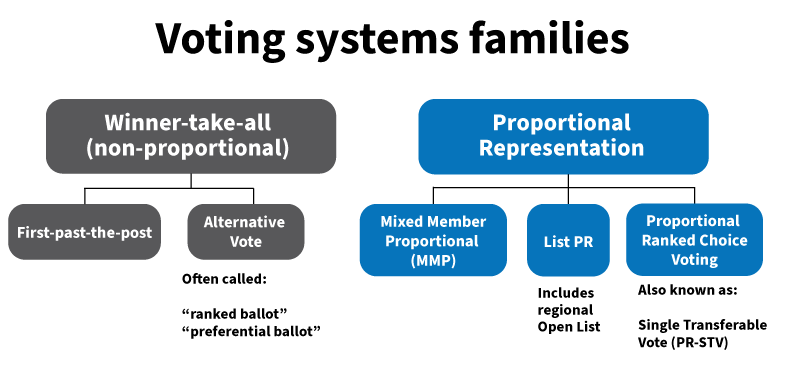
There are two main “families” of voting systems –
winner-take-all systems and proportional systems:
A winner-take-all ranked ballot system produces results that are just as bad as first-past-the-post, and can distort results even more than first-past-the-post.
Proportional systems that would work very well in Canada can also use a ranked ballot.
However, when people say “ranked ballot” or “preferential ballot” they almost always mean the winner-take-all system, properly called Alternative Vote (AV).
National polling shows that 68% of Canadians support proportional representation, the principle that if a party gets 40% of the vote, they should get about 40% of the seats.
National polling also shows that 87% of Canadians would oppose a single party unilaterally changing the electoral system without the agreement of any other party.
Multi-party agreement is the way almost every country with proportional representation in the OECD adopted PR. That does not mean every party is going to agree, but usually several parties had to negotiate and compromise to make the system proportional.
Video: The problems with winner-take-all ranked ballot
Video: Who benefits from winner-take-all ranked ballots?
The problems with winner-take-all ranked ballots
Winner-take-all ranked ballots can deliver results that are even less proportional than first past the post.
Expert testimony to the federal Electoral Reform Committee concluded that winner-take-all ranked ballot was the one system that could deliver results that were less proportional than first past the post.
The UK Independent Commission on the Voting system concluded the same thing.
False majority governments will continue just like with first past the post—governments will get all the power with less than 50% of the vote.
In fact, of the 28 majority governments in Australia since 1949 (which uses winner-take-all ranked ballots) only ONE had the support of 50% of voters. Like first-past-the-post, winner-take-all ranked ballots can also lead to “wrong winner elections”. This means Party A wins more of the popular vote (more voter support) but Party B forms a majority government. This has happened multiple times in Australia.
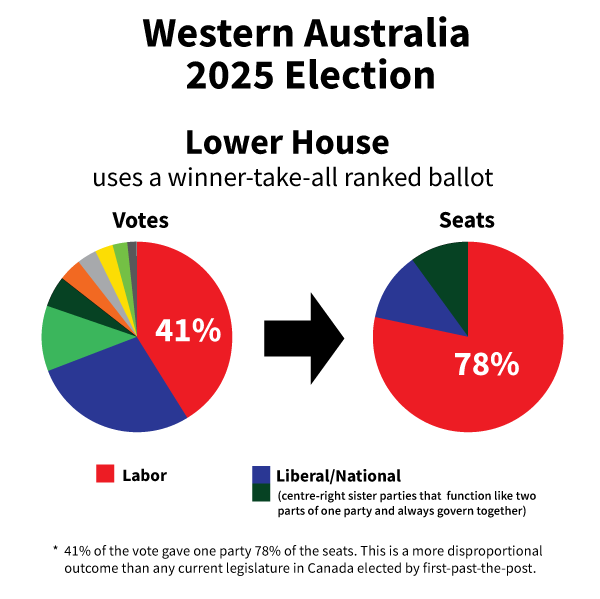
Winner-take-all ranked ballots risk exaggerating landslides for one party even more than first-past-the-post.
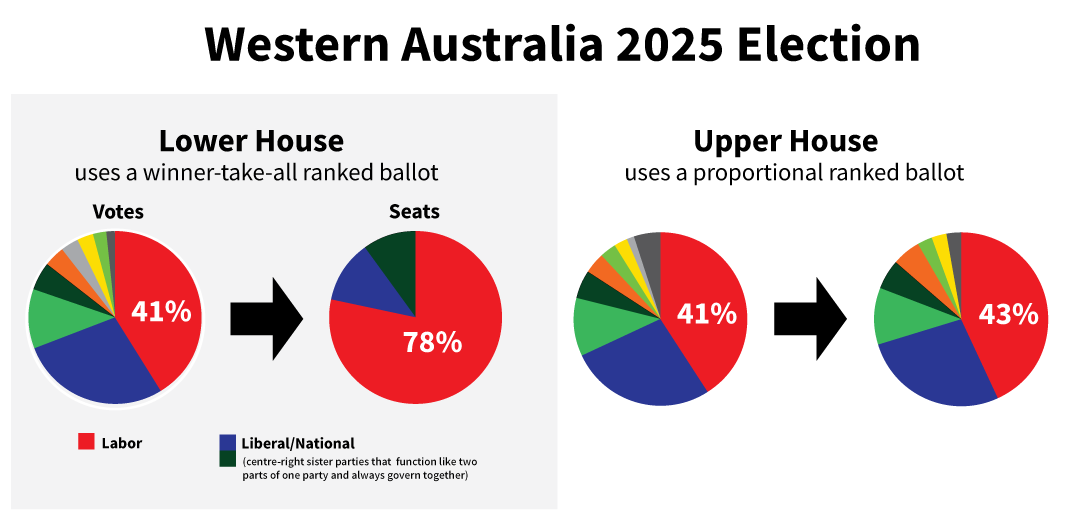
The 2025 state election in Western Australia is a case in point.
They elect their lower house with winner-take-all ranked ballots.
With winner-take-all ranked ballots, a party with 41% of the vote got 78% of the seats.
The Liberal and National Parties (the other two parties that got seats) function like two branches of one party in Australia (they have run and governed together on the right for decades).
Voters for all the other parties got squeezed out, and the result is a two party duopoly.
Winner-take-all ranked ballots are not supported by evidence
In 2016, the federal all-party Electoral Reform Committee (ERRE) spent five months taking an in-depth look at electoral reform options. Hundreds of experts were called from Canada and around the world.
88% of the experts recommended proportional representation and only 4% recommended winner-take-all ranked ballots.
There was less support among experts for winner-take-all ranked ballots than for first past the post.
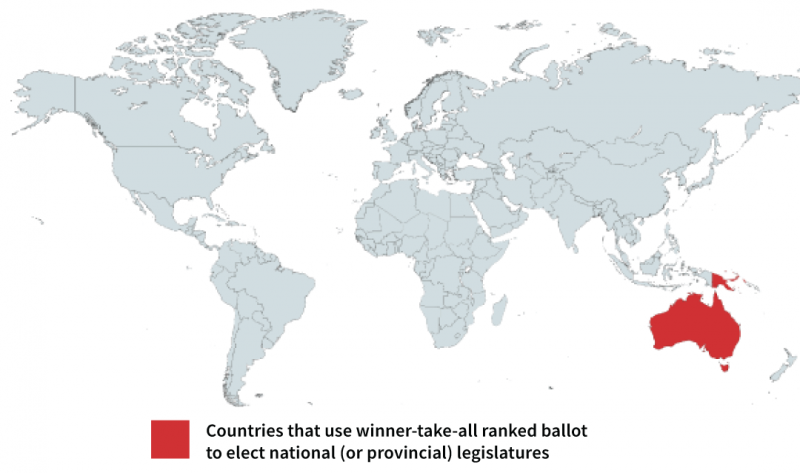
There are only two countries that use winner-take-all ranked ballots to elect governments at the national level or a level equivalent to a provincial level: Australia and Papua New Guinea. By contrast, over 80% of OECD countries use proportional systems.
Winner-take-all ranked ballots can make it harder for voters of third and smaller parties to be fairly represented, and push us closer to a two-party system.
The one thing winner-take-all ranked ballots have done well in Australia is to funnel almost all the votes for third parties and smaller parties into the baskets of the two big tent parties through preferences.
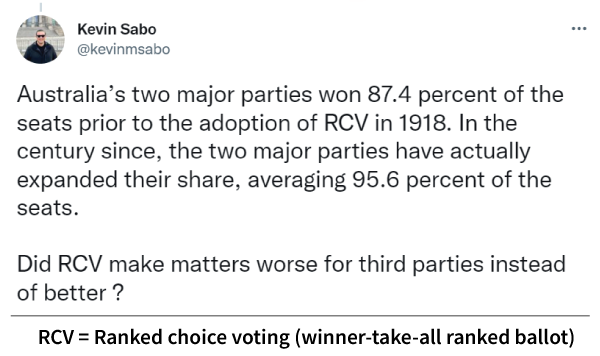
Instead of more accurately reflecting the diversity of the voters, winner-take-all ranked ballots could make the near-monopoly the two big parties have in our system even worse.
As Kevin Sabo notes:
For example, for years the Green Party in Australia regularly got over 10% of the popular vote, but until 2022, they were only ever been able to elect ONE MP to Parliament.
They had more popular support but less representation than Greens had in Canada under first-past-the-post.
(In the 2022 Australian election Greens finally got 4 MPs – that’s 2% of the seats with 12% of the vote).
In 2019 in Australia, parties other than the big two parties got over 25% of the vote – but only 3% of the seats.
Winner-take-all ranked ballot can make it harder for new challengers to break into the system.
When winner-take-all ranked ballot was used for forty years on Canada’s prairies, a greater number of parties ran in the election, but no more parties won seats than with first past the post.
A winner-take-all ranked ballot is not a stepping stone to PR.
Any system that advantages and concentrates power with the biggest parties will make those parties even less likely to support proportional representation. It is a step to nowhere.
Australia’s Parliament has had winner-take-all ranked ballot for over 100 years.
When winner-take-all ranked ballot was used on Canada’s prairies for decades, reformers hoped it would lead to PR, but advocacy fell on deaf ears. Eventually the politicians brought back first past the post. The same thing happened in British Columbia when one party brought in winner-take-all ranked ballot for a few years – hoping to advantage themselves – in the 1950’s. A few years later, a different party just brought back first past the post.
Winner-take-all ranked ballots will continue adversarial, hyper-partisan politics we see with first-past-the-post.
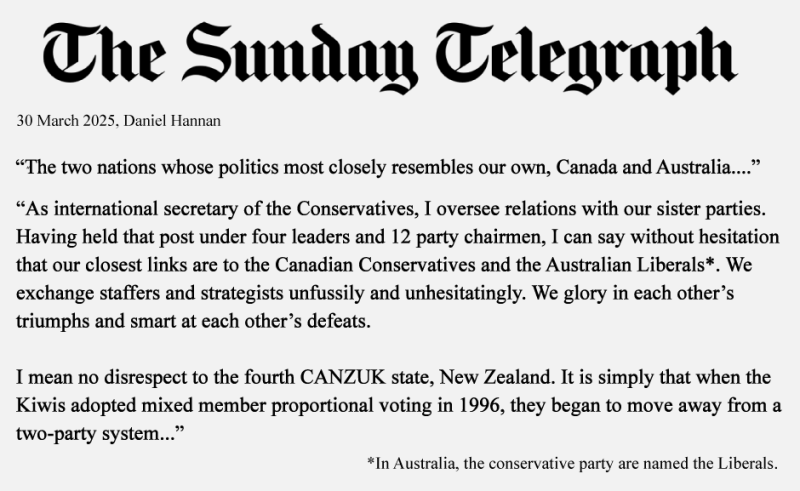
In March 2025, the International secretary of the Conservatives observed in the UK Telegraph that Canada (first-past-the-post), the UK (first-past-the-post) and Australia (winner-take-all ranked ballots), all share the same kind of politics:
Claims that a winner-take-all ranked ballot will change the tone of national or provincial politics are exaggerated or downright misleading.
CLICK TO SEE REAL POLITICAL ADS FROM AUSTRALIA.
When the UK had a referendum on winner-take-all ranked ballot in 2011, impartial experts warned not to expect improvement in the tone of politics, except “at the margins”.
Researchers at Harvard and Columbia University concluded that Alternative Vote, instead of encouraging moderation, can even “intensify candidates’ incentives to target their core supporters at the cost of a broader appeal.”
Under winner-take-all ranked ballot, elections will remain a vicious fight mainly between two big parties.
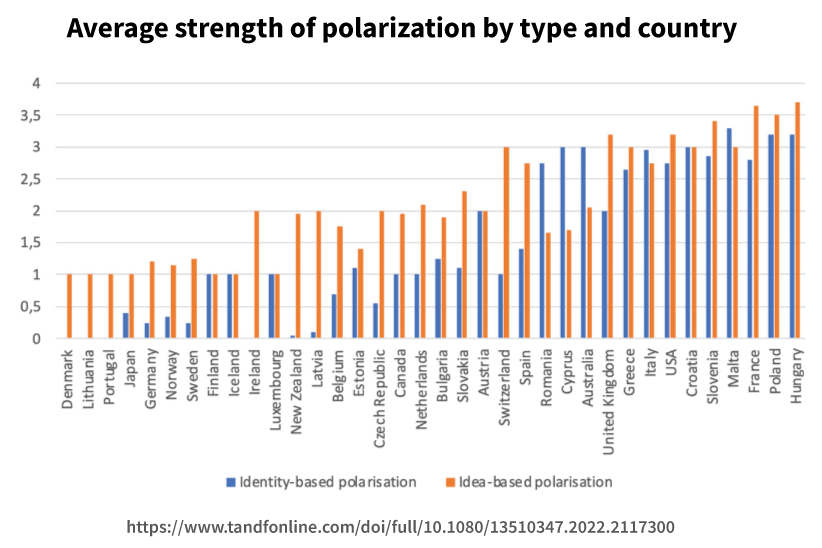
Research shows that politics in Australia, under winner-take-all ranked ballot, is more polarized than it is in Canada with first-past-the-post.
In fact, debate became so hostile a few years ago that MPs were booted from the Parliament by the Speaker hundreds of times over just a couple of years.
There is little cooperation between parties in in the lower house because the winner-take-all ranked ballot almost always produces false majority governments. This means the two parties attack each other in hopes of gaining or keeping 100% of the power at the next election.
Read more about what kind of results winner-take-all ranked ballot has produced in Australia here.
Winner-take-all ranked ballots don’t solve the problem of “policy lurch”.
Policy lurch occurs when one government almost completely reverse the policies of the previous government. For example, Jason Kenney promised to spend the first 100 days undoing Rachel Notley’s policies.
Policy lurch has had a devastating effect on climate policy in Australia (read more about this on our blog). Australia ranked last for policy on the 2021 Climate Performance Index and near the bottom for overall performance.
Evidence shows that countries with proportional representation outperform winner-take-all countries on climate performance, in part because they are able to make progress and sustain it.
Winner-take-all ranked ballots are highly likely to benefit one party at the expense of other voters.
Different experts (going back to 1980), numerous simulations, and an actual mock vote run alongside an election (where voters could vote with different systems) have all shown the same thing: winner-take-all ranked ballots would often benefit the Liberal Party at the expense of other voters.
When the Liberals push a winner-take-all ranked ballot, it’s clearly for their own self-interest.
Being the second sincere or strategic choice of voters to the left and right in swing ridings, the Liberals would very likely win even more the seats despite having no more popular support than they do now. This could deliver grossly exaggerated false majority governments even more frequently, where no compromise or power-sharing between parties is required.
Click here to read more on winner-take-all ranked ballot and Liberal Party self-interest.
Ranked ballots in a proportional versus a winner-take-all system
Proportional representation means that the seats a party earns roughly matches their popular vote.
39% of the vote = about 39% of the seats. Almost every vote really counts.
A ranked ballot can be used in a proportional system (such as proportional ranked choice voting), or in a winner-take-all system.
You can see the huge difference in outcomes below.
The first picture shows the difference between the results in the Lower House (winner-take-all ranked ballot) and the Upper House (proportional ranked ballot) in Western Australia’s 2025 election. Same parties, same voters, same day – very different results.
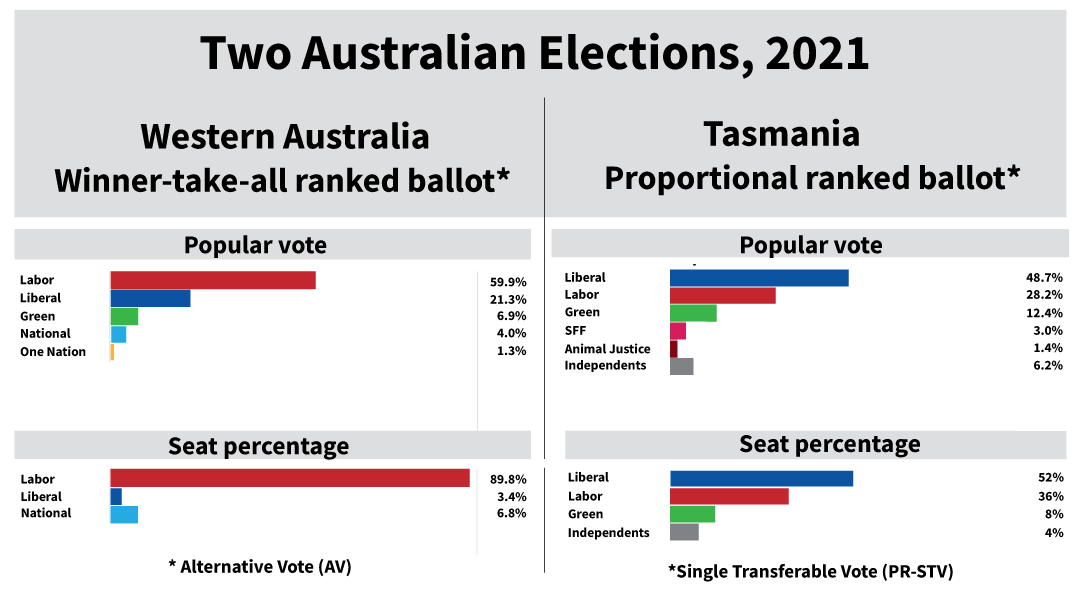
The second picture shows Western Australia’s 2021 election with winner-take-all ranked ballot and Tasmania’s 2021 election with a proportional ranked ballot. Again, the difference between a winner-take-all system and a proportional system is obvious.
Learn more about the problems with winner-take-all ranked ballots:

RANKED BALLOT IN AUSTRALIA
Some politicians say winner-take-all ranked ballot will make politics more “cooperative” or deliver fairer results. But in Australia, winner-take-all ranked ballot has locked in a two party system and created politics that is just as aggressive as ours. The current “majority” government was elected with 32.8% of first choice votes. Click to learn more about what you really get with winner-take-all ranked ballot.

The only ones who benefit from adding a ranked ballot to first past the post federally and in Ontario are the Liberal Party. Winner-take-all ranked ballot makes it even easier for them to win more seats and all the power with far less than half the vote. Click here to learn more.

GET THE FACTS FROM ANNA KEENAN, ORIGINALLY FROM AUSTRALIA
Climate organizer and democracy campaigner Anna Keenan explains how winner-take-all ranked ballot really works in Australia from firsthand experience, why we shouldn’t be fooled by politicians, and the benefits of a Citizens’ Assembly on Electoral Reform. Click here to watch a series of short video clips.

Take a deep dive into the problems of the winner-take-all ranked ballot in this webinar.

EXPERT DENNIS PILON
One of Canada’s top electoral reform experts, Professor Dennis Pilon, answers questions about winner-take-all ranked ballot. Click here to read more.