

Chip in for an Ontario provincial poll on support for proportional representation!
In the days since Ontario Liberal leader Steven Del Duca pledged to force winner-take-all ranked ballots on Ontario—or he’ll resign—the uproar from citizens just keeps getting louder:
Ontarians don’t want one party leader’s hand-picked system forced on voters—a system that can deliver more distorted results than first-past-the-post.
It’s time to stop this train wreck and get electoral reform back on track!
With no sign in the media yet that the Ontario Liberals are rethinking their position, it’s time to get louder.
Will you help us fund a poll of Ontarians asking if they support proportional representation—and if they’d prefer an independent, non-partisan citizens’ assembly to lead the way?
With the Ontario provincial election just eight months away, it’s hard to overstate how serious this situation is.
Winner-take-all ranked ballots (properly called Alternative Vote, or AV) will not deliver the fair results, cooperative politics and good governance that Ontario voters deserve!
Time and again, the only beneficiary of winner-take-all ranked ballots has been shown to be the Liberal Party.
Simulations going back decades federally show Alternative Vote would have given the Liberal Party even bigger phony majorities.
Provincially, new simulations by expert Byron Weber Becker show:
Even their 2011 minority government would have been turned into a majority.
The Liberals would not have done worse with AV in any election going all the way back to 1987! In only one election (1990) would they have ended up with the same number of seats as under FPTP. In every other election, they would have won more seats.
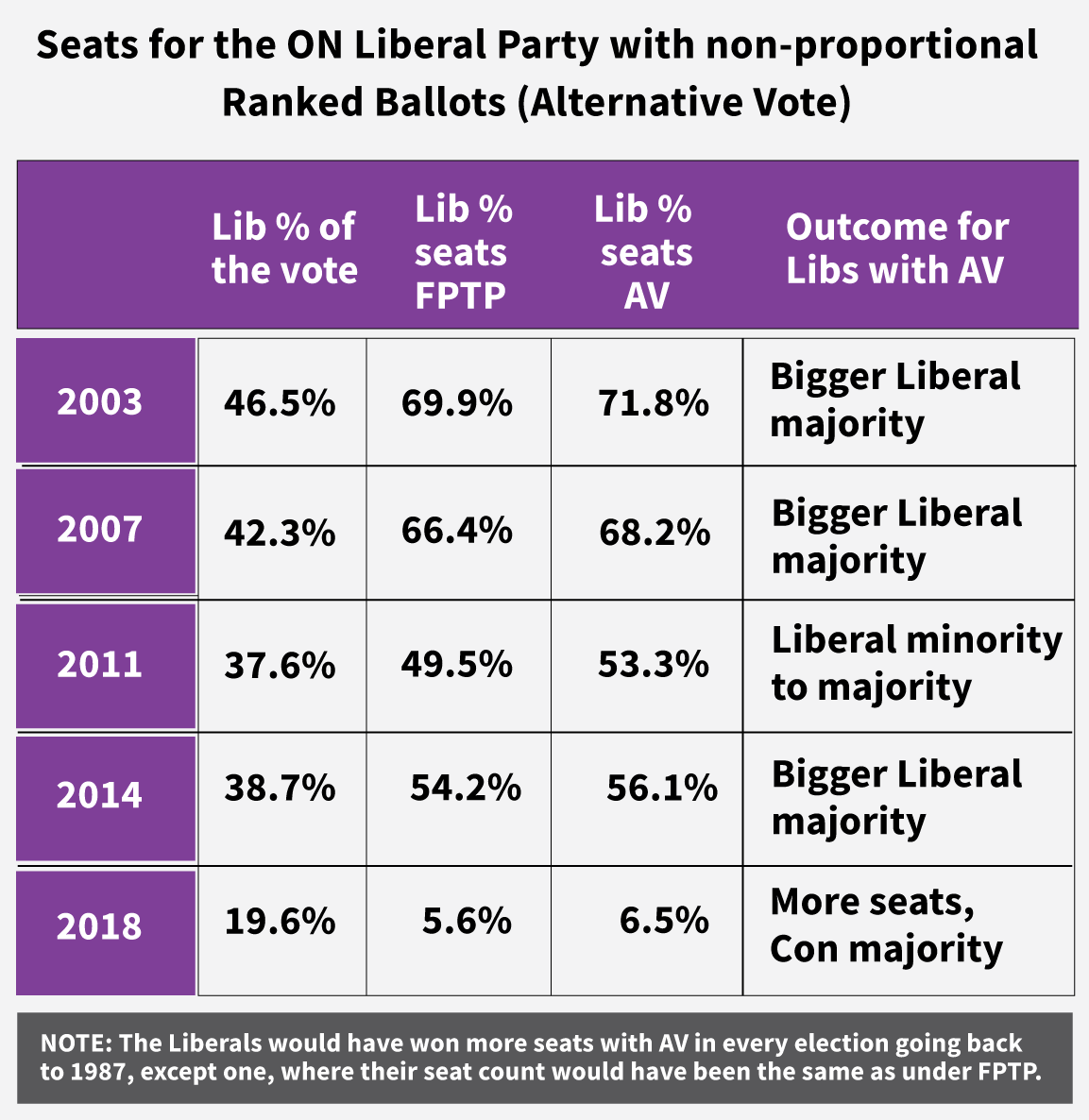
Alternative Vote is more disproportional than first-past-the-post
Expert testimony to the federal Electoral Reform Committee showed that winner-take-all ranked ballot was the one system that would deliver more disproportional results than first-past-the-post.
The United Kingdom’s Independent Commission on the Voting System concluded the same thing:
“Far from doing much to relieve disproportionality, AV is capable of substantially adding to it.”
A very recent real-world contrast between proportional representation and Alternative Vote can be seen below in two elections this year in Australia at the state level.
Western Australia uses the winner-take-all ranked ballot (Alternative Vote).
Tasmania, by contrast, uses a proportional ranked ballot (Single Transferable Vote – PR-STV).
The difference couldn’t be more stark.
With the winner-take-all ranked ballot, a party with 60% of the vote got a whopping 90% of the seats in the legislature, leaving almost no representation for other voters.
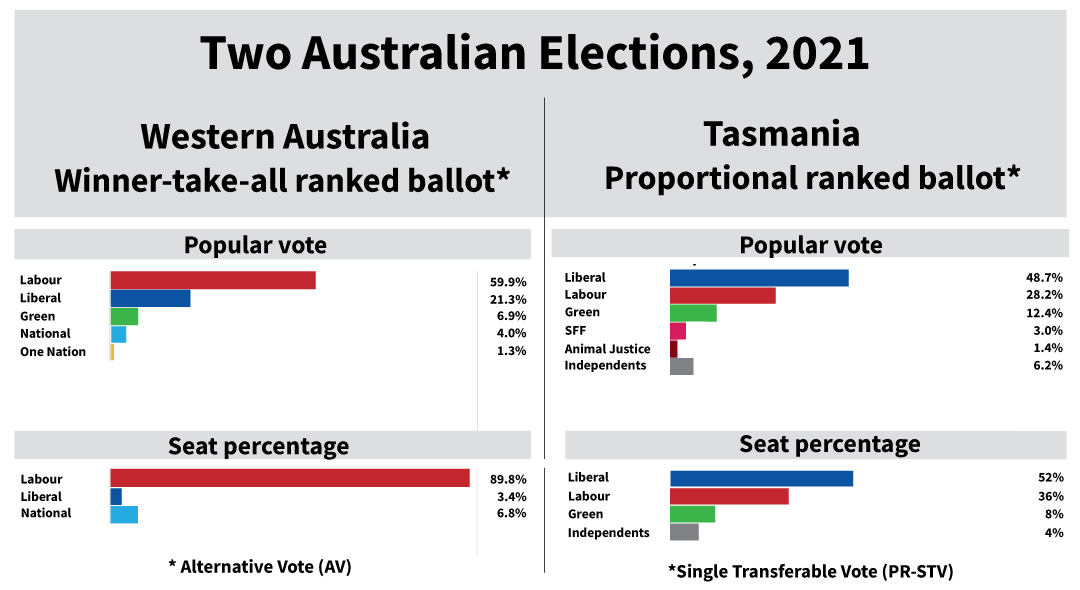
This is well-established fact: with Alternative Vote, voters for third parties and smaller parties can be almost entirely shut out.
For example, voters for the Australian Green Party have never won more than one seat in Australia’s lower house, even though the party obtained 11.8% of the vote in 2010 and 10.5% of the vote in 2019.
Overall in 2019, parties other than the big two got 25.3% of first preference votes but only 3.3% of the seats.
More cooperative politics?
The Ontario Liberals know that “electoral reform” is a hugely popular promise—and Ontarians want leadership!
Voters want exactly the outcomes from their voting system that Steven Del Duca spoke about:
“In fact, I believe they long for an approach that emphasizes collaboration, ideas and respect.
One that reduces the opportunity for leaders and parties to vilify each other….”
A Leger poll in 2020 showed that a whopping 97% of Canadians want an electoral system that encourages parties to work together more often in the public interest!
But winner-take-all ranked ballots will deliver the opposite.
Over 100 years in Australia, Alternative Vote has shaped their politics into a highly partisan, viciously adversarial, rigid two-party system.
“Blood sports” and “disorder contrived to make the evening news” is how experts describe Australian politics under AV.
Minority governments—which would encourage cooperation—are rare.
Grossly inflated majorities and false majorities are the norm.
A stepping stone to nowhere
History is clear: any hope that Alternative Vote would lead to proportional representation is wishful thinking.
As Associate Professor and Canada’s top electoral reform expert Dennis Pilon said recently:
“If you adopt the Alternative Vote, that’s what you get. That’s where you are. It’s not some sort of evolutionary step to something else.”
When you concentrate power at the top even more than it is today, it’s harder than ever to wrestle it back.
We can turn this around if we act now!
After years of unaccountable false majorities—and the steady growth of the proportional representation movement—this could be our moment!
It’s incredibly exciting—and a testament to your hard work—that electoral reform is moving to the front burner in the upcoming Ontario provincial election.
We can’t let partisan agendas drive this into the ditch.
We can build a province where everyone’s voice matters—with proportional representation.
We must push hard now for leadership to deliver an evidence-based process we can trust!
Please chip in for an Ontario electoral reform poll now.