Fair Vote Canada applauds Mark Carney’s positive statements about working on electoral reform. We strongly support his position that the Prime Minister’s personal opinion shouldn’t decide the issue – and Canadians agree with him.
At an event in Sault Ste. Marie, Carney explained that electoral reform was not in the Liberal platform because they are focused on addressing the economic crisis, but suggested that they may pursue a process for electoral reform after the economic crisis had abated.
Mark Carney stated:
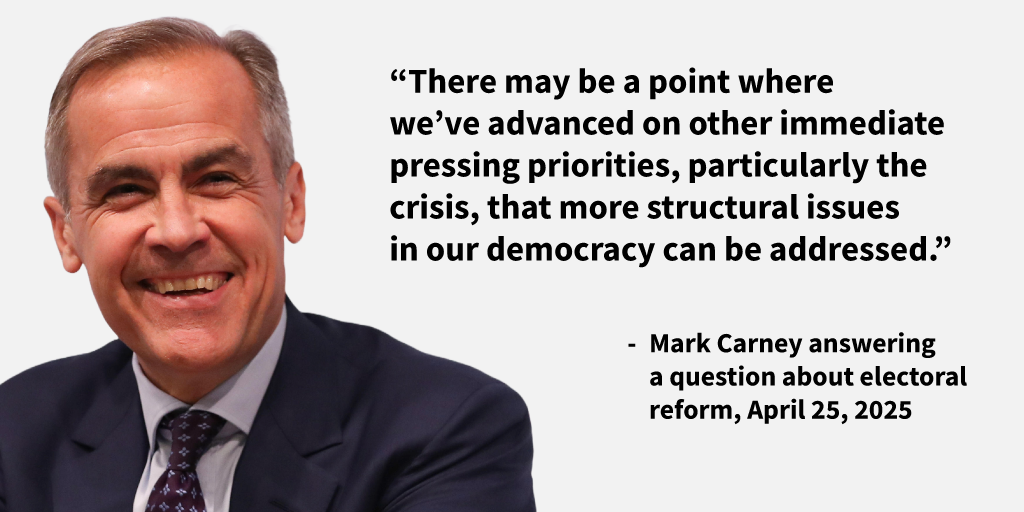
“I will give you my personal view on it, which is that a Prime Minister should be neutral on these issues, so that a process, if a process is developed, that they are objective and not being seen to tip the scales in one direction or another.
And I think that, if I may, looking back on what happened previously, that probably part of what stalled progress on it.So, there may be a point where we’ve advanced on other immediate pressing priorities, particularly the crisis – that’s our intention – that those more structural issues in our democracy can be addressed.”
Carney’s clear break with Justin Trudeau’s approach to electoral reform is a welcome development. It lays the foundation for real progress on proportional representation.
Justin Trudeau’s obstinate insistence on a winner-take-all ranked ballot system as the only option he would even consider, despite strong support among experts and citizens for proportional representation, shut down the possibility of progress for years.
Mark Carney’s open mindedness and desire for a constructive process is a breath of fresh air.
Canadians are witnessing, in real time, the dangers of a deeply polarized, winner-take-all system where all the power can be handed to one party and concentrated with one person.
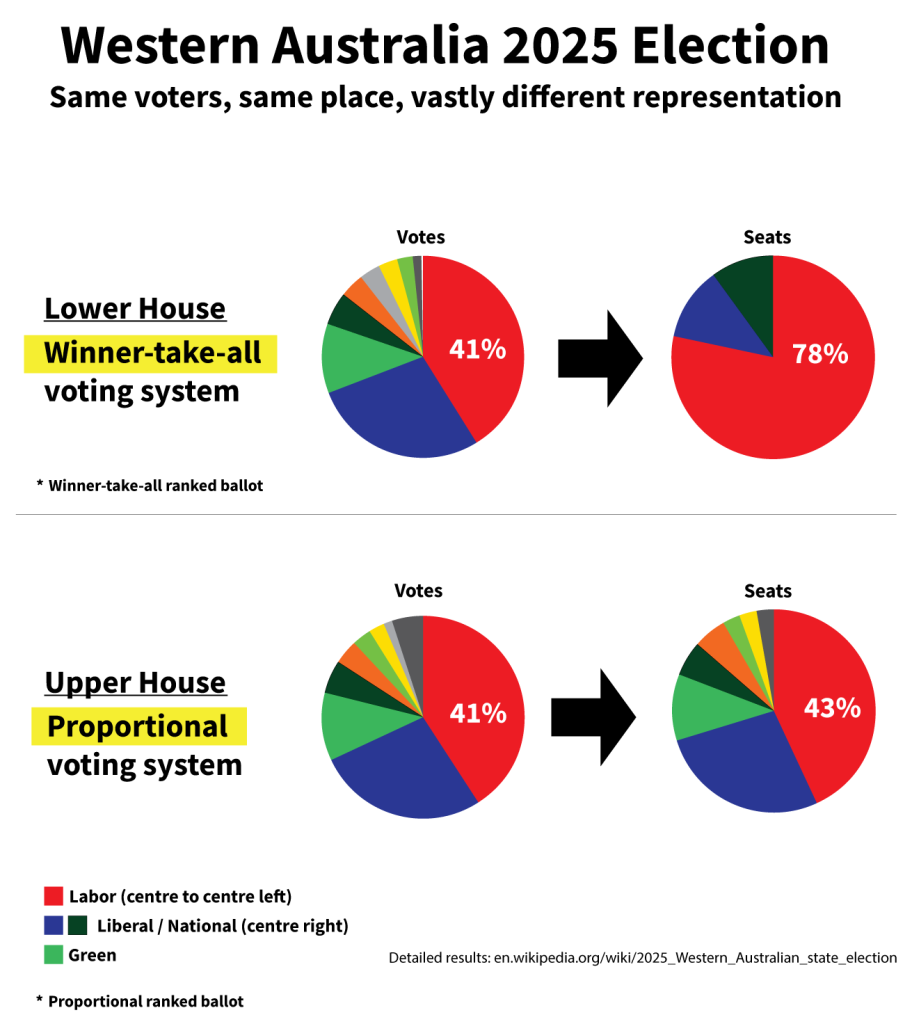
In Canada, a majority government can be formed with just 39% of the vote. This is a problem shared by all countries with winner-take-all systems. In the last UK election, a majority government was formed with just 33% of the vote. In the last Australian election, with a winner-take-all ranked ballot, a majority was formed with 32% of the vote.
Proportional representation is not one system but a principle that seats in Parliament should reflect the popular vote. About 80% of OECD countries use electoral systems based on the principle of proportional representation.
Countries with proportional representation like Germany, Ireland and Denmark, are demonstrating how strong, stable and cooperative governments can meet crises and tackle long-term challenges.
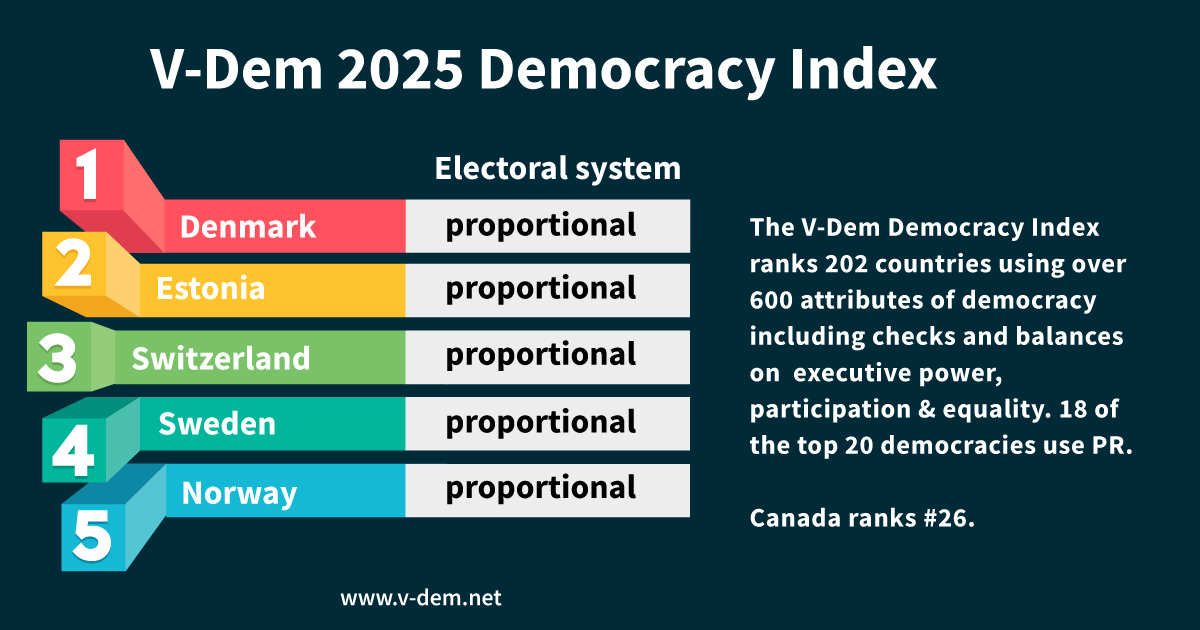
Research shows that democracies that use proportional representation are less polarized. All the top ten democracies on the V-Dem Democracy Index use PR.
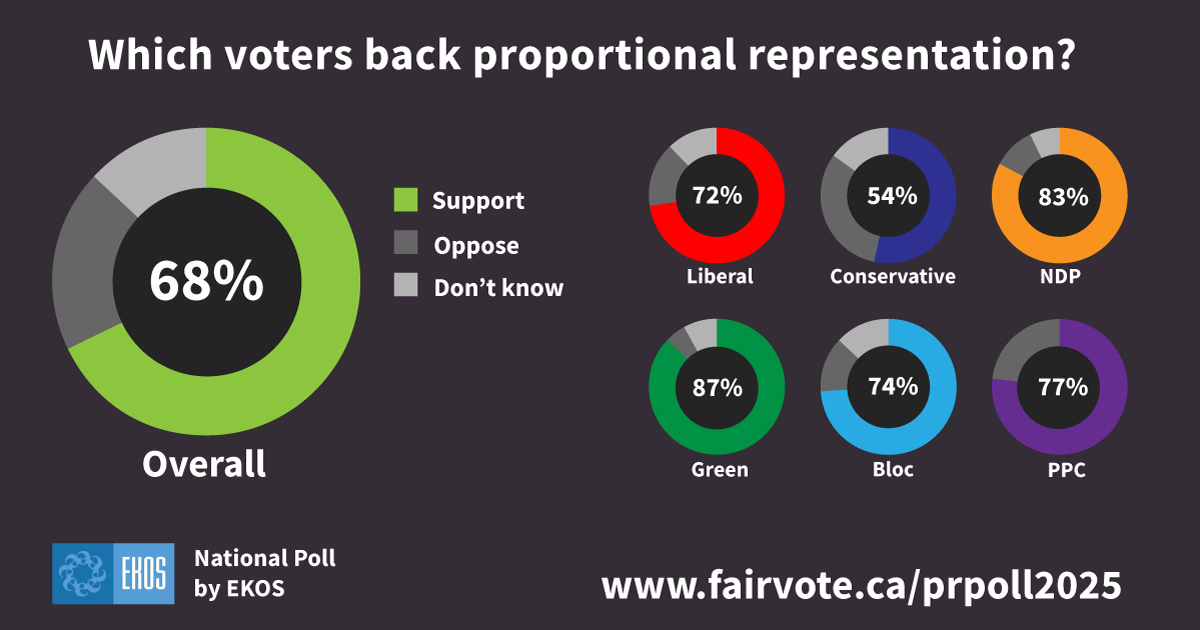
An EKOS poll in 2025 showed that 68% of Canadians support proportional representation, with only 21% opposed.
Around the world, proportional representation almost always happens by multi-party agreement – meaning two or more parties negotiate and compromise.
An independent, non-partisan Citizens’ Assembly on Electoral Reform is a good way to include the feedback of citizens in the process of negotiating change. This idea received strong support from the Liberal Party’s grassroots at their 2023 policy convention.
The years ahead are time for courageous and forward-thinking leadership.
Mark Carney has said that we can build the strongest economy in the G7.
Let’s build the strongest democracy in the OECD, too.