
How did other countries get proportional representation?
One of the most common questions people ask is, “How did other countries get proportional representation?”
The political moment that opens the door to PR is unique in each country. The “how” PR happens done boils down to one thing:
Multi-party agreement.
In almost every country with proportional representation, parties were willing to negotiate, compromise and hammer out an agreement.
This does not mean every party agreed in every case.
While proportional representation levels the playing field for everyone, it’s not going to be in the short-term self-interest of every party at the same moment. Although in many cases, parties across the political spectrum did agree, including those on the right).
See below for a chart of how OECD democracies adopted PR.
Fair Vote Canada encourages parties to start the conversation that could lead to a multi-party agreement with a National Citizens’ Assembly on Electoral Reform.
For a more detailed assessment of voting system change over time in Western Europe and Anglo-American countries, including majoritarian systems, see this analysis by Associate Professor Dennis Pilon or watch the webinar on how other countries adopted PR.
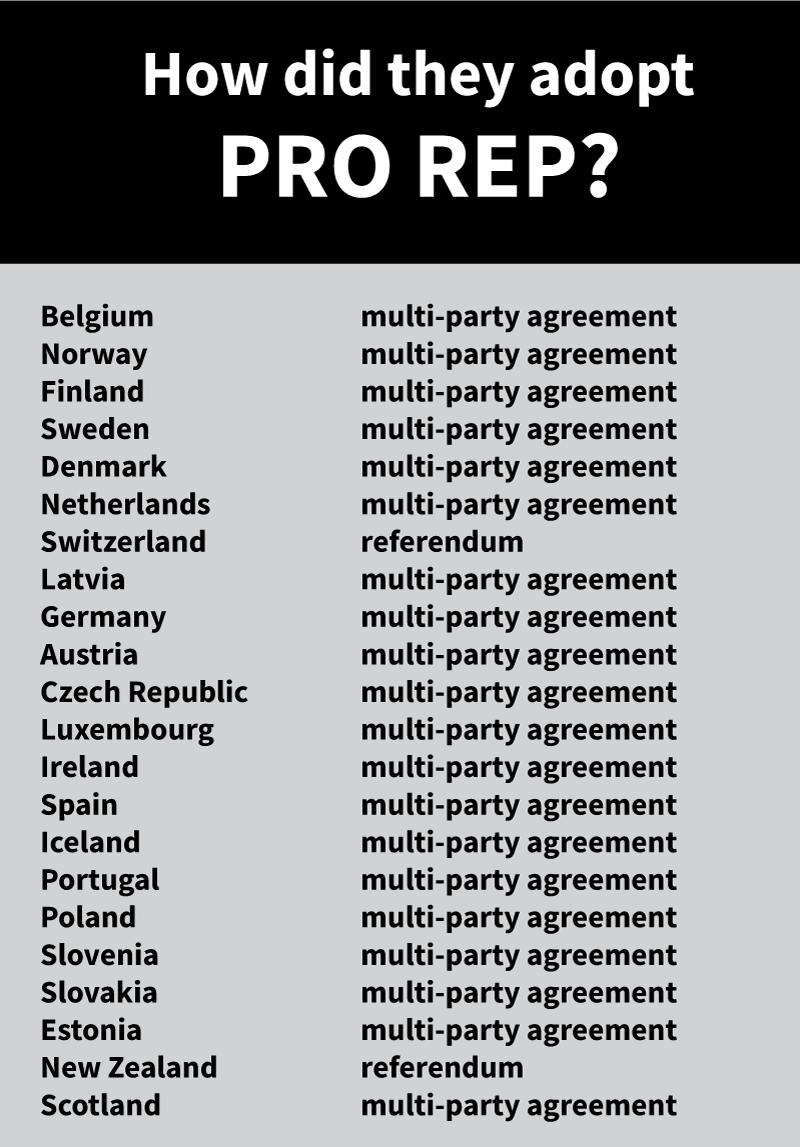
How OECD democracies that use proportional representation adopted PR or subsequently revised their PR system
This table includes only countries use that use proportional representation currently and are rated as "free" democracies by Freedom House. This chart does not include countries with majoritarian or mostly majoritarian systems. See research by Dennis Pilon for an fuller analysis of Western European and Anglo-American countries and their electoral system transitions over time.
How did other democracies change their electoral systems?
Electoral reform expert Dennis Pilon looks at the real world politics behind how countries adopted proportional representation, the role of multi-party agreements, and what reformers can learn from history.
Associate Professor Dennis Pilon is author of two books and many chapters and journal articles on the history and politics of electoral reform in Canada and around the world.