
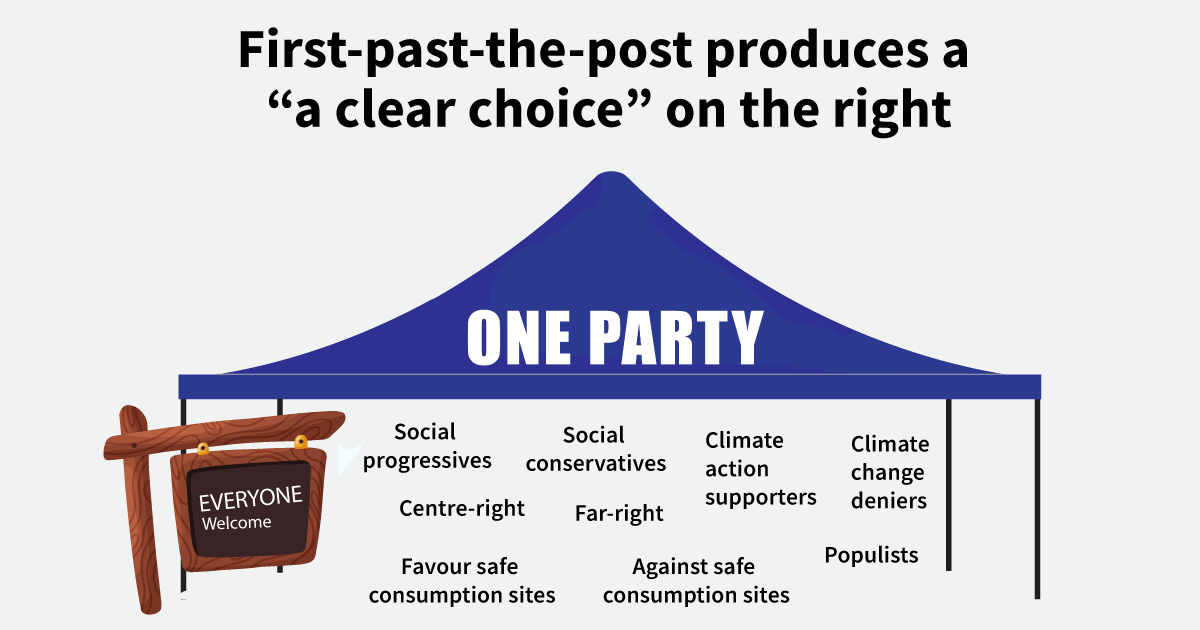
In the blink of an eye, BC United leader Kevin Falcon and BC Conservative leader John Rustad have wiped out voter choice, and forced BC back to a two-party system.
The reason for this high-stakes shotgun marriage between BC United (formerly the BC Liberals) and the BC Conservatives is both transparent and compelling: parties and voters to the right of the BC NDP know they can’t win if they split the vote.
Overnight, the withdrawal of BC United has left hundreds of thousands of voters politically homeless. Voters are right to question how much these two parties really have in common. Even former BC Liberal cabinet ministers are calling foul and publicly musing about voting for the BC NDP.
Until two days ago, BC United MLAs and candidates were stoking fear that the BC Conservatives were too extreme to be trusted. Since BC United leader Kevin Falcon’s abrupt about-face, he is not only urging his supporters to get behind the BC Conservatives, but expecting his own candidates to spout talking points from the BC Conservative platform.
What are voters supposed to believe?
As the BC Conservatives attempt to shoehorn newly orphaned BC United MLAs into their party, nobody is sure what the BC Conservative Party will stand for.
In this case, not knowing what the party stands for may be a selling point.
In an era of polarized politics, cheap populism and dumbed-down slogans, “We’re not the BC NDP” may be all the coherence and transparency voters are going to get. It could well be enough to propel the BC Conservative Party to a majority government.
The abrupt removal of the BC United party from the ballot comes at a time when many Canadians are already disillusioned with their political choices.
Time and again, thanks to the harsh incentives of our first-past-the-post system, our political choices are taken away from us as viable parties dissolve or fold into each other. In some cases, more extreme factions are welcomed into a bigger party’s tent, where they can rise to positions of power, forever changing the nature of the party.
Federally, the Progressive Conservatives and the Reform Party each reflected unique histories and values before they joined forces―but those principles were sacrificed on the altar of political expediency
Similar scenarios have played out provincially in BC, Alberta, and New Brunswick. Discrete parties who each commanded a respectable share of the vote have been forced into uncomfortable alliances based on shrewd political calculations .
In the long run, paucity of choice and concentration of power in the hands of a few costs us all. The consolidation of our political parties means that diverse voters on the left, centre and right are unjustly treated as monolithic blocks.
Canada is increasingly a country of monopolies. Media monopolies. Telecom monopolies. Grocery monopolies. Most Canadians hate them.
Anyone with a modicum of “common sense” can tell you that less competition doesn’t deliver better results.
In the political arena, the dangers of a polarized, two-party political system are on full display in the United States. A brutal fight between right and left rages relentlessly in an environment where the possibilities for political cooperation and compromise have become almost nil.
The consequences of pernicious polarization are not lost on Canadians. A hopelessly polarized political system tops Canadians’ greatest fears, and they’re right to be concerned. The Economist’s 2023 Democracy Index warned that Canadian politics are beginning to veer into American-style problems.
Canadians want to see collaboration between parties to solve our problems.
From housing to health care to climate change, we need dialogue and cooperation among parties from across the political spectrum to create and sustain long-term progress. In many countries with proportional representation, cooperation across the aisle is the norm and better long-term outcomes are the result.
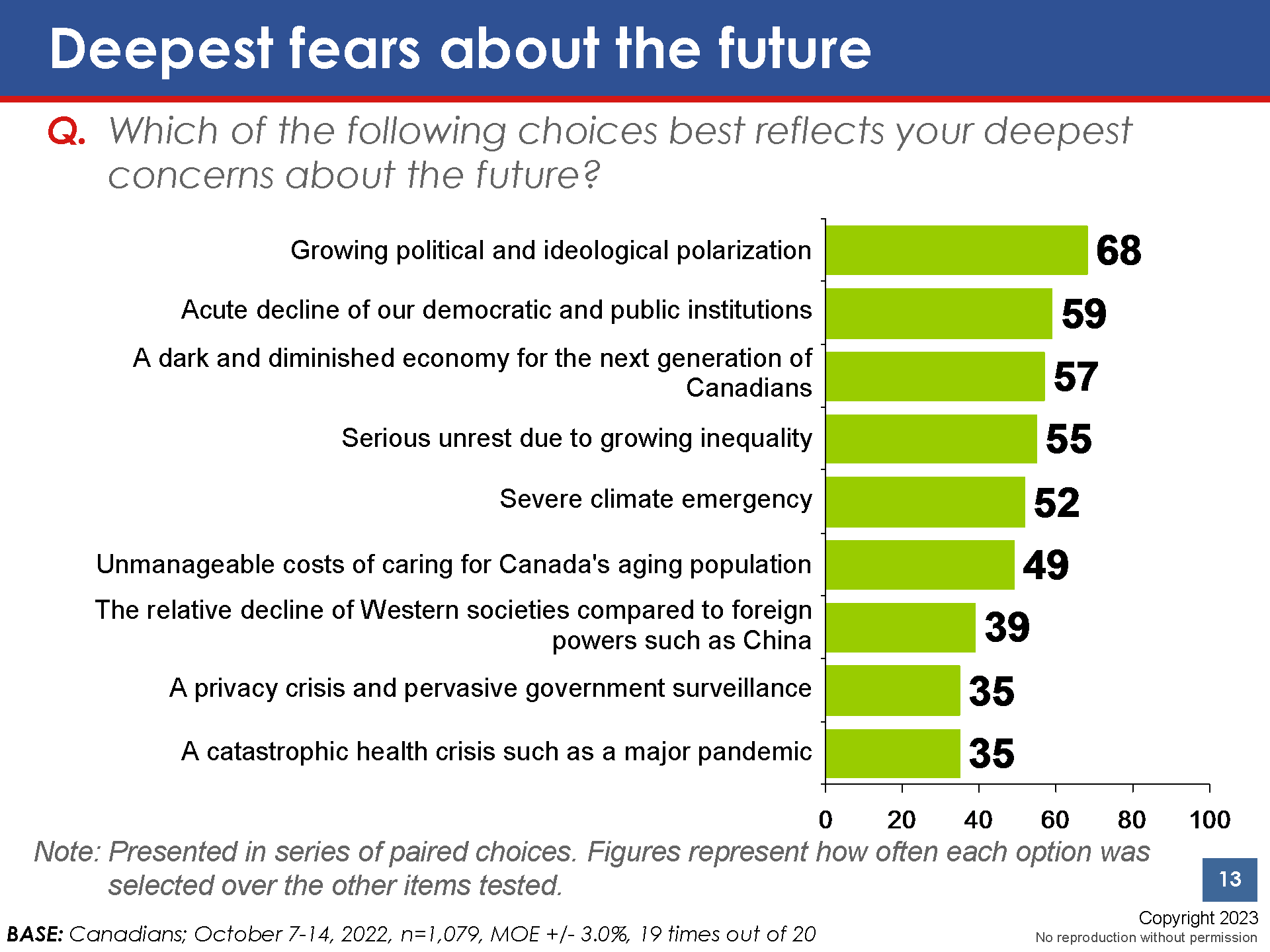
With first-past-the-post, we can’t count on any plan lasting more than a few years. Small changes in voting patterns can propel a new party into a majority government with less than 40% of the vote. Severe policy reversals can occur when governments change. On the most important long-term issues, successive cycles of policy whiplash mean that we’re essentially going in circles.
Over the long run, two-party systems serve nobody but the most partisan politicians who thrive on them.
Nobody should be surprised when half of the electorate don’t show up to vote.
The marriage of BC United and the BC Conservatives should not be a cause for celebration, no matter where one sits on the political spectrum.
First-past-the-post works against voters’ best interests. When choice gets cut in the pursuit of power, we all lose.