
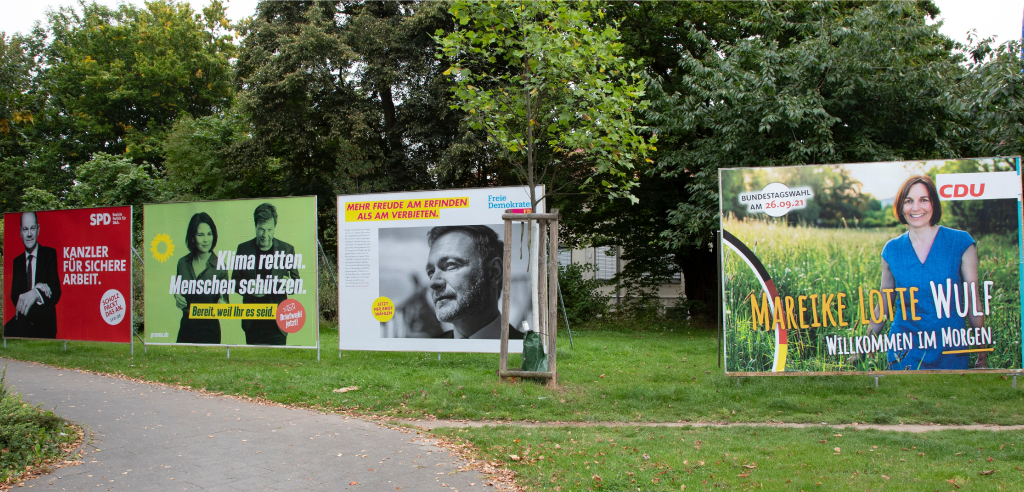
Photo: Hameln, NRW, Germany, election posters for the federal election 2021, liberals, CDU, green party and SPD
In a forward-thinking move, Germany’s three-party coalition government is collaborating with the mainstream conservative opposition party to safeguard Germany’s top court from the risk of partisan manipulation and extremism.
The move will mean that any changes to the ground rules of the Federal Constitutional Court will require the support of two-thirds of MPs.
In Germany, proportional representation already provides a strong level of protection against decision-making by parties with only minority support, including extremists.
Seats in Parliament reflect the popular vote, so that every vote counts. Stable coalitions have formed every German government since 1961, and often include parties with perspectives from across the political spectrum.
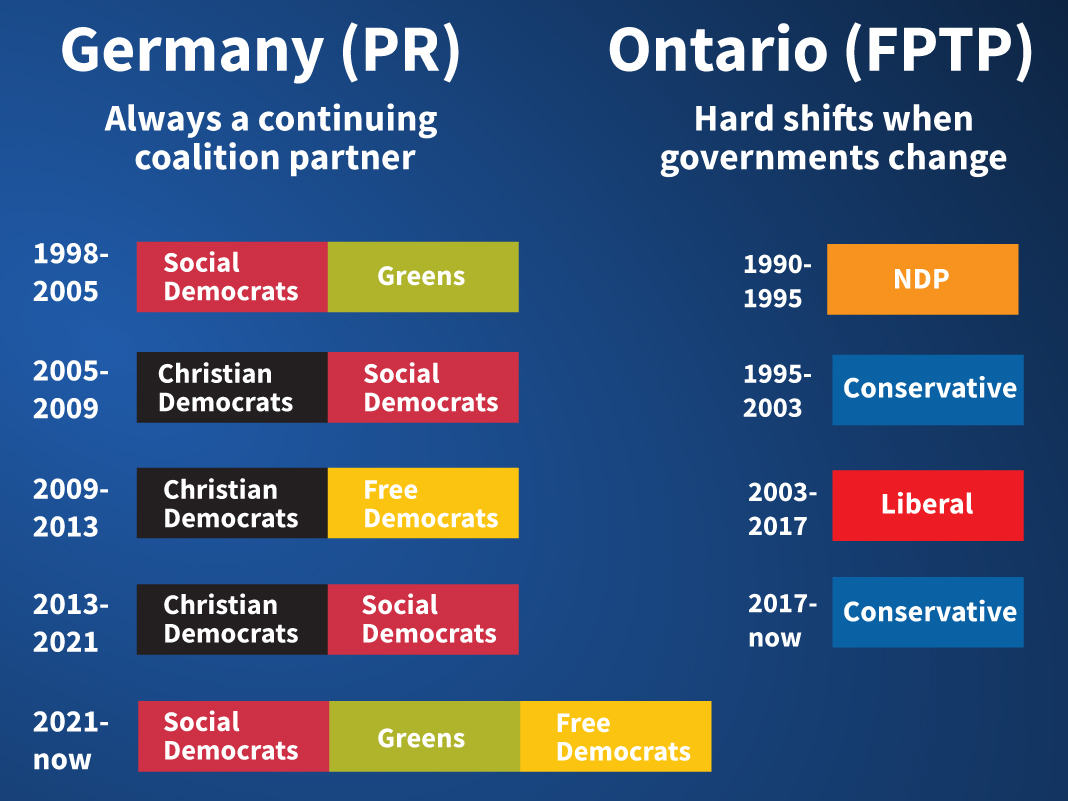
Broader cross-party cooperation on important, long-term issues is not uncommon in countries with proportional representation. This kind of cooperative politics was on full display in 2020, when Denmark passed the strongest climate legislation in the world. The legislation was the result of collaboration between nine parties, including conservatives.
Could the Supreme Court in Canada be politicized?
Many Canadians look with alarm and despair at the politicization of US courts, while feeling reassured that our own courts look safe from such partisan manipulation.
Could Canada’s Supreme Court become politicized?
In Canada, currently a non-partisan and independent Advisory Board provides a short list of judicial candidates to the Minister of Justice. The Minister of Justice consults with the Chief Justice of the Supreme Court, provincial and territorial attorney generals, the House of Commons Standing Committee on Justice and Human Rights, and the Standing Senate Committee on Legal and Constitutional Affairs.
The final choice of a new judge from the list generated by this non-partisan process is made by the Prime Minister.
The risk is not in the current selection process itself, but the fact that it can be unilaterally changed at any time by a Prime Minister.
Changes to the process to select our Supreme Court judges are not unusual. Changes were made by Paul Martin, kept in place by Stephen Harper, then changed again to the current process by Justin Trudeau. These changes have thus far upheld the importance of a non-partisan selection process.
What is to prevent a future Prime Minister from creating a new process to stack the bench with political sympathizers?
In Canada: nothing.
(The only official check on the Prime Minister’s decision is the Governor General, but in practice the Governor General will follow the advice of a Prime Minister who has the confidence of the House).
Our coveted tradition actually dates since only 2004. Like an unwritten agreement between parties, Prime Ministers using a non-partisan process is the only safeguard we have to prevent the appointment of judges from turning into a political nightmare. Even that process wavered in 2015 when Harper appointed an outlying candidate.
What happens if the political consensus on non-partisan appointments breaks down?
Considering the increasing level of partisan hostility, it’s a question that should give Canadians pause.
As the Public Policy Forum’s report “Far and Widening” outlines, there’s no doubt politics is becoming more polarized in Canada. The Economist’s Democracy Index warned this year: “Canada increasingly appears to be suffering from some of the same democratic deficits as its southern neighbour… Polarization has become a growing feature of Canadian politics.”
Doug Ford’s recent partisan appointments to the selection committee for Ontario court judges shows just how quickly the traditional political consensus on how the levers of power should be used can unravel.
Proportional representation can help mitigate the risk
Single-party “majority” governments in Canada are routinely elected with 39% of the vote.
Once in power, Canada’s Prime Minister wields tremendous power, including the power to determine many of the rules of democracy.
In recent years, a dangerous political environment is emerging that could put our cherished traditions and conventions at risk.
Polarizing portrayals of opponents are rewarded with clicks and donations. Countries with winner-take-all voting systems already subject citizens to majority rule by a single party that only a minority voted for. In the United Kingdom, the Labour Party just won a landslide majority government with a mere 33% of voter support.
When a party and its leader are seen as an enemy that must be stopped, important political norms and boundaries start to erode. Outcomes that were previously unthinkable could become more likely.
If we want to reduce the risks of polarization and minority rule, the research is clear:
- Proportional representation mitigates issue-based and identity-based polarization.
- In democracies with proportional representation where coalition governments are the norm and often cross the political spectrum, citizens feel more warmly towards parties they didn’t vote for when those parties have been in a coalition with their preferred party anytime in the past fifteen years – even when those parties are ideologically far apart.
In other words, proportional representation would pave the way for a less polarized political environment.
At a minimum, by institutionalizing collaboration between parties, proportional representation would make it much more difficult for a single party leader to unilaterally control the selection of judges or change the rules of the Supreme Court.
Like the parties in Germany’s government, our parties could work together now to secure a stronger democracy for the future.
In the face of dangerous polarization south of the border and the warning signs of similar patterns in Canada, electoral reform can’t wait.