

Does first–past-the-post keep out “extremists”—or empower them?
Opponents of proportional representation often claim that first-past-post protects us from extremists having a voice and influence in Parliament.
One look at the convoy in Ottawa—particularly its leaders and high profile, elected supporters―should put that fantasy to rest.
We have now seen American-style extremists marching on the grounds of our Parliament, waving swastikas and the confederate flag. It was clearly wishful thinking to hope that by shutting out voices like the People’s Party on election day, they would just wither quietly away.
First-past-the-post puts our democracy at greater risk than proportional representation, by far.
The organizers of the convoy are largely folks with connections to right-wing hate and conspiracy groups. According to the Canadian Anti-Hate Network, the project was co-founded by a former Wexit (fringe party) organizer whose white-supremacist hate speech is well documented.
The convoy’s Ontario organizer was linked to Soldiers of Odin.
Another organizer was associated with the anti-immigrant Yellow Vest protests.
Another is on record saying ““Islamist entryism” is “rotting away at our society like syphilis.”
That’s not to suggest that all―or even most―of those people waving from the side of the road would agree with all the hate that is driving the organizers. In fact, It’s hard not to feel badly for the majority of Canadian truckers who condemn the actions on Parliament Hill, and feel the entire project misrepresents their position.
This is where first-past-the-post is supposed to kick in and protect us, right?
By ensuring that the voices of those who espouse such extreme views, and their supporters, are marginalized―not amplified?
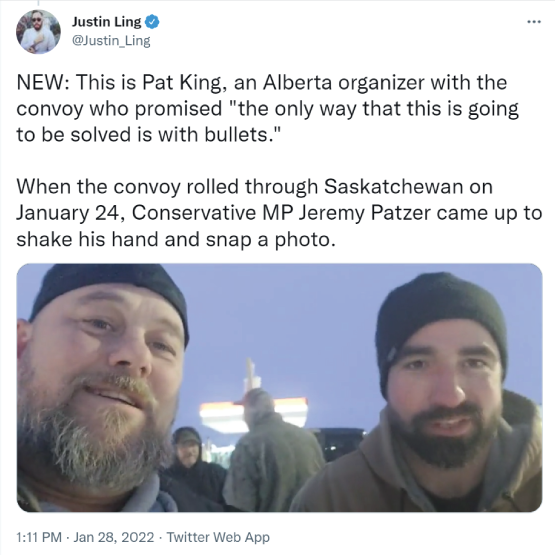
Except, we saw the opposite. The organizers make no secret of their hateful views. Yet prominent politicians who hold considerable power are rubbing elbows with them:
- Conservative Party MP Jeremy Patzer sought out organizer Pat King, the man who stated “the only way out of this is with bullets”, for a photo op
- Conservative MP and former leader Andrew Scheer encouraged the protests by calling Trudeau “the biggest threat to freedom in Canada”
- And of course Conservative Party leader, Erin O’Toole, struggled to publicly welcome the convoy while distancing himself from the organizers, those defacing statues, and those waving nazi flags. As Summa Strategies Elliot Hughes said:
“You almost feel bad for the guy, until you remember that he sort of invited this upon himself when he made a deal with the party right-wing to win the leadership.”
And this is exactly what you get with a winner-take-all electoral system.
Left, right, fringe, extremist―all are shoehorned into big tent parties. As this Conservative Party member on Twitter noted, the need to appease multiple viewpoints has left the party “a mess”. The only thing that holds these marriages from hell together is the tantalizing possibility of winning all the power.
After the 2021 federal election, some pundits against proportional representation were concerned about the People’s Party potentially winning seats under PR. Realistically, there might have been six or eight PPC seats in a well-designed proportional system: a rump in independent’s corner.
We are now looking at what first-past-the-post can deliver instead: the leader of our Official Opposition welcoming the convoy in an attempt to satisfy his own “fringe” supporters.
The risk of extremists gaining significant influence exists with any winner-take-all system that forces unlikely bedfellows into a big tent.
Similar dynamics occur under the winner-take-all ranked ballot being pushed by Ontario Liberal Leader Steven Del Duca.
In Australia, which uses the winner-take-all ranked ballot, Conservative Prime Minister Scott Morrison refuses to discipline a high profile anti-vax MP in his caucus who promotes the “great reset” and other conspiracy theories on US far-right conspiracy talk shows.
How far can this policy of appeasement be carried under a winner-take-all voting system? For those who don’t find the Donald Trump years to be sufficiently illuminating, it’s worth pointing out that former Cabinet Minister Maxime Bernier lost the 2017 Conservative Leadership race by only 1.9% in the final count.

That’s how close Canada came to having a “freedom fighter” as the leader of our Official Opposition, and possibly even as our Prime Minister.
With first-past-the-post, a party needs only 30-something percent of the vote to form a “majority” government.
Proportional representation, by contrast, prevents minorities with extreme views from gaining control.
First, proportional representation helps ensure transparency.
When MPs with “extreme” views are in their own small party, voters know what they’re voting for. They don’t get a nasty surprise by seeing their MP on TV in a photo op.
Research shows that proportional representation doesn’t actually increase the number of people voting for far-right parties, either. Given a clear option, voters don’t flock to the extremes.
Crucially, after the election, European countries find that PR almost always helps isolate extremists in the legislature.
If a small far-right party’s policies are too far out of line with mainstream opinion, the other parties will cooperate with each other, to ensure the smaller (extremist) party is excluded from government.
This has happened in Sweden, Germany and the Netherlands.
Real world experience and research suggests making votes count works to deliver better health outcomes, stronger environment protections, and a growing economy.
In other words, priorities that the vast majority of Canadians want their politicians working on, not a troubling sideshow.