Fair Vote Canada statement on the Yukon plebiscite on Ranked Vote
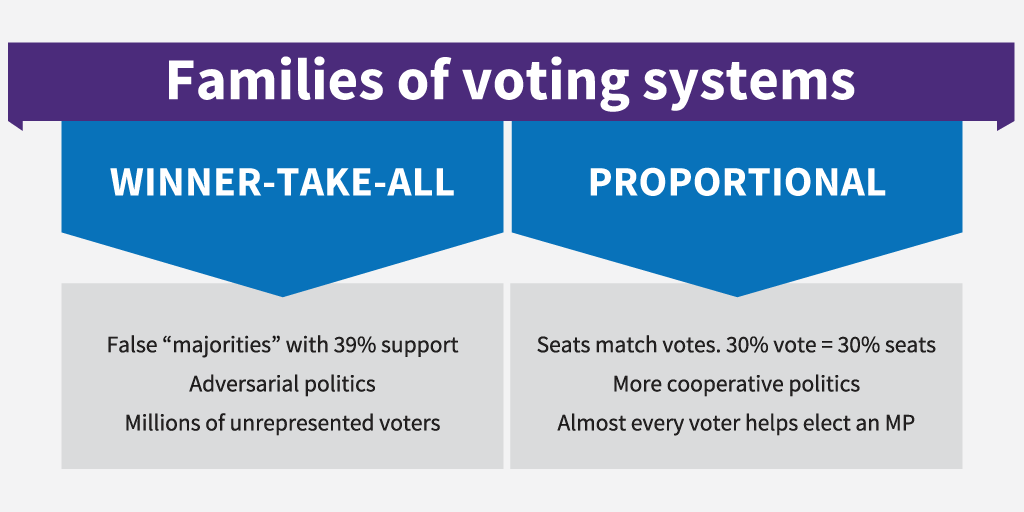
Fair Vote Canada is an organization for proportional representation. That means that if a party gets 30% of the vote, they will get about 30% of the seats. Almost every voter will cast a ballot that helps elect a representative – almost every vote will count.
Proportional representation is the principle behind the electoral systems of the highest ranked democracies in the world, and is used by over 80% of OECD countries.
The Yukon is having a plebiscite on “Ranked Vote”. There is no single system identified by political scientists named Ranked Vote.
The plebiscite is on a system properly called Alternative Vote, a winner-take-all system that uses a ranked ballot.
Fair Vote Canada does not support Alternative Vote (“Ranked Vote”).
As a winner-take-all system, Alternative Vote is no more proportional than first-past-the-post. It wastes the votes of millions of voters and leads to false majority governments. It can distort results even more than first-past-the-post, leading to even bigger single party landslides.
In a time of increasing polarization, research shows that countries with proportional representation, by providing fair and accurate representation and leading to more cooperative politics, are less polarized. The only OECD country to use Alternative at the national level, Australia, has a higher level of affective polarization than Canada.
There is no real world evidence that switching from one winner-take-all system to another is a stepping stone to proportional representation. A system that makes it extremely difficult for political minorities to obtain fair representation, and disproportionality concentrates seats and power with a couple of big parties, is unlikely to produce additional reforms.
Fair Vote Canada respects the right of Yukoners to make their own decision about whether to adopt Alternative Vote for their territorial elections.
Fair Vote Canada will not be engaging on either side of the Yukon referendum.
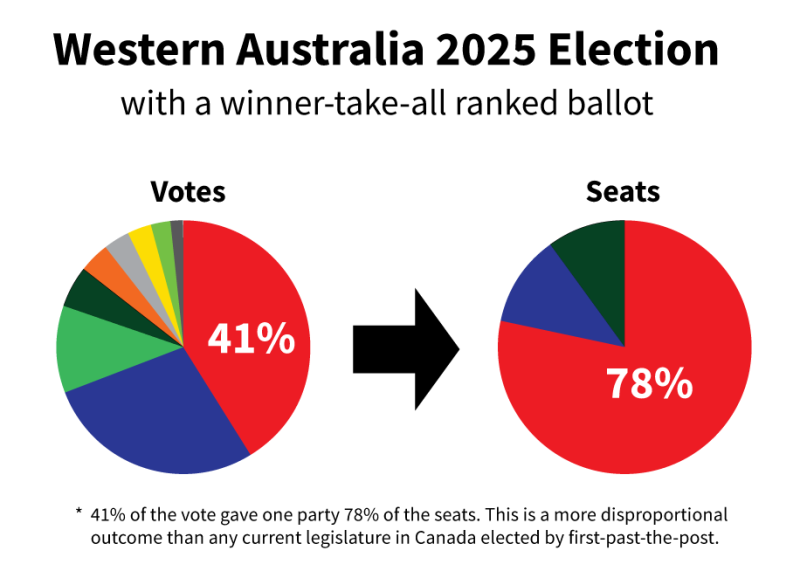
From the submission of Byron Weber Becker, electoral systems expert who modelled elections for numerous systems showing how they performed under different conditions for the federal all-party committee on electoral reform:“The Alternative Vote (better named Instant Runoff Voting) is attractive to many Canadians. I used to advocate for it myself, but now consider it to be an example of The Tragedy of the Commons. In that economic example, the self-interest of individuals works against the best interest of the entire community. Advocates of Alternative Vote are acting in the self-interest of each individual riding. AV tends to yield a compromise candidate that is acceptable, at some level, to a majority of the riding’s voters. ** But just like the Tragedy of the Commons, the cost to the entire community – Canada as a whole – is huge. My simulations indicate that the 2015 election under Alternative Vote would have increased the Liberal over-representation from 15% to 24%. They would have gained 63% of the MPs on only 39.5% of the first choice ballots. The Composite Gallagher Index of 24% is the worst of any system I simulated. As a result, I believe the adoption of AV would be a fundamental violation of the committee’s first principle of Effectiveness and Legitimacy.” ** But not always! Sometimes what would be the consensus candidate is dropped early and voters are left with one of the extremes. Furthermore, it can deliver quite unintuitive results. See http://zesty.ca/voting/sim/ for simulations at the individual riding level. |