
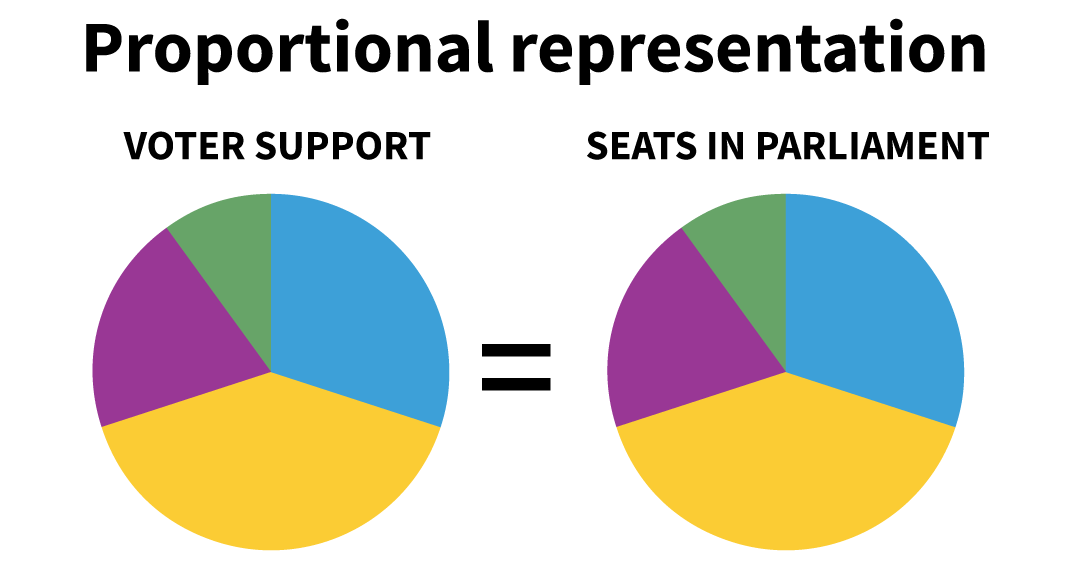
What is proportional representation?
Proportional representation (PR) is a principle that says the percentage of seats a party has in the legislature should reflect the percentage of people who voted for that party. If a party gets 40% of the vote, they should get 40% of the seats.
Under our non-proportional voting system, a party can win a majority of seats and all the power with far less than half the popular vote.
Proportional representation ensures that majority governments have an actual majority of the voters behind them.
Under our non-proportional voting system, in most elections, most voters don’t elect anyone to represent them. They don’t affect the election at all. Their votes are “wasted”. This is what leads to distorted results.
With PR, almost every vote helps elect an MP. Almost everyone is represented.
With PR, every law passed will have the support of MPs representing a real majority of voters. That means better policy decisions for everyone.
Proportional Representation 101: A short video
Proportional Representation 101
Are you new to electoral reform and want to get up to speed on the basics of proportional representation? How do the most popular systems recommended in Canada work? What about “ranked ballots”? Check out “Proportional Representation: A Crash Course” webinar with electoral reform expert Professor Dennis Pilon. Watch the video here.