Winner-take-all ranked ballots are not a stepping stone to proportional representation
Position statement passed by the FVC Board of Directors January 4, 2026
Background: position on winner-take-all ranked ballots (proper system name: Alternative Vote or Instant Run-off Voting)
Fair Vote Canada is a campaign for proportional representation: the principle that the seats in the legislature should closely reflect the popular vote.
We oppose winner-take-all systems such as first-past-the-post and winner-take-all ranked ballots.
Learn more about why we don’t support winner-take-all ranked ballots (Alternative Vote)
What about winner-take-all ranked ballots as a “stepping stone” to proportional representation?
Some proportional representation supporters have suggested that switching from first-past-the-the-post to winner-take-all ranked ballots could be a stepping stone to proportional representation. They suggest that adopting winner-take-all ranked ballots as a “first step” would make it easier to get proportional representation.
Fair Vote Canada does not support this strategy because it is not grounded in evidence.
First-past-the-post and Alternative Vote (winner-take-all ranked ballots) are both winner-take-all systems, and thus both suffer the same structural problems.
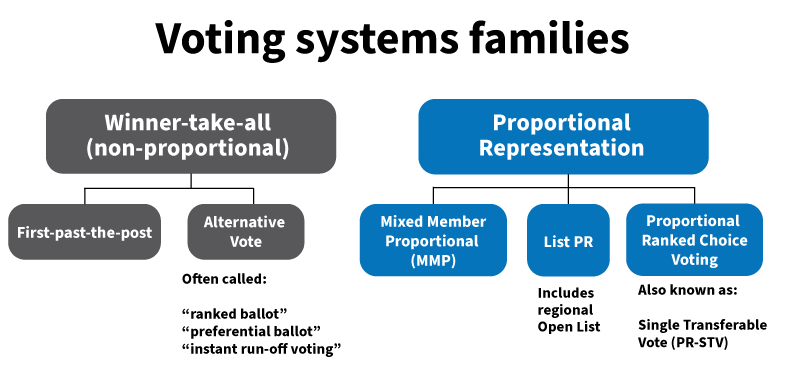
First-past-the-post and winner-take-all ranked ballots behave in much the same way.
They waste the votes of millions of voters, produce badly distorted overall results, and lead to false majority governments.
As with any winner-take-all system, the parties who benefit from massive seat bonuses do so because other voters are denied fair representation.
There is no real world evidence that switching from one winner-take-all system to another is a first step to proportional representation.
Australia, the only OECD country to use winner-take-all ranked ballots at the national level, has had it for over 100 years. They are no closer to proportional representation in their national legislature than Canada is, and in fact, have seen almost total domination by two parties for most of the past century, and only one minority government.
Western Canada (Alberta and Manitoba) used winner-take-all ranked ballots provincially in their rural ridings between the 1920s and 1950s (while proportional ranked ballots were used for a minority of seats in some cities). Reformers initially had hopes that winner-take-all ranked ballots would evolve into proportional representation, but no progress was ever made on that front. After thirty years, the government brought back first-past-the-post. After BC used winner-take-all ranked ballots for two provincial elections, they also brought back first-past-the-post.
Multi-party systems – legislatures with multiple strong parties – is usually a prerequisite to moving to proportional representation.
When a winner-take-all system is no longer working as well for the biggest parties, and the smaller parties have more of a presence and more leverage for change, the odds of a multi-party agreement to move to PR increases.
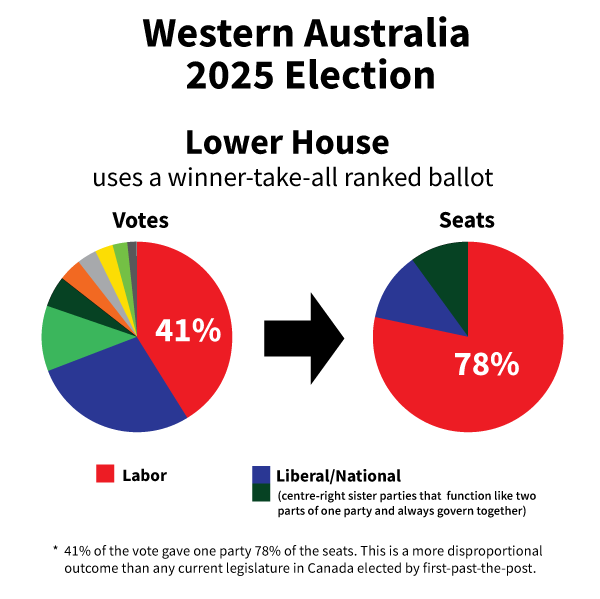
A particular risk of winner-take-all ranked ballots is that while generally it replicates the kind of results we see with first-past-the-post, it can sometimes produce even bigger (disproportionate) landslides for the winning party (see example in picture below), squeezing voters for third and smaller parties out almost entirely.
Any system that makes it extremely difficult for third and smaller parties to obtain fair representation, and disproportionality concentrates seats and power with a couple of big parties, is unlikely to be a “stepping stone” to PR.
Incremental progress would be well worth supporting, but it must not simply be a switch from one winner-take-all system to another.