
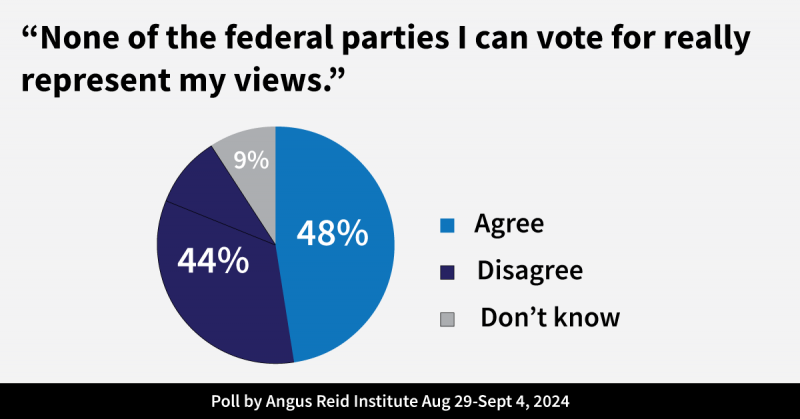
The latest poll by Angus Reid lays bare the obvious; many Canadians can’t find a party they want to vote for.
Half of all respondents agreed that they don’t have a voting option that really represents their views.
This lack of meaningful choice is a feature, not a flaw, of our first-past-the-post system. Winner-take-all voting serves up a limited menu of big tent parties, some of which are little more than marriages of convenience. The merger of the federal Progressive Conservatives and the Reform Party is a prime example of what happens when voter choice is sacrificed in pursuit of power.
In the most recent example, BC United leader Kevin Falcon disbanded his party’s election campaign overnight in order to shore up the BC Conservatives; now BC is barely more than a two party system.
Ironically, Falcon justified axing voter choice in the name of helping the “free enterprise” side.
Federally, the major parties who enjoy the stranglehold on power that first-past-the-post has given them cling to our uncompetitive system even when the public is fed up with their lack of choice. Just like the grocery and telecom giants, they would much rather tolerate unhappy consumers with nowhere else to go than to support proportional representation which would open up the market to give competitors a fighting chance.
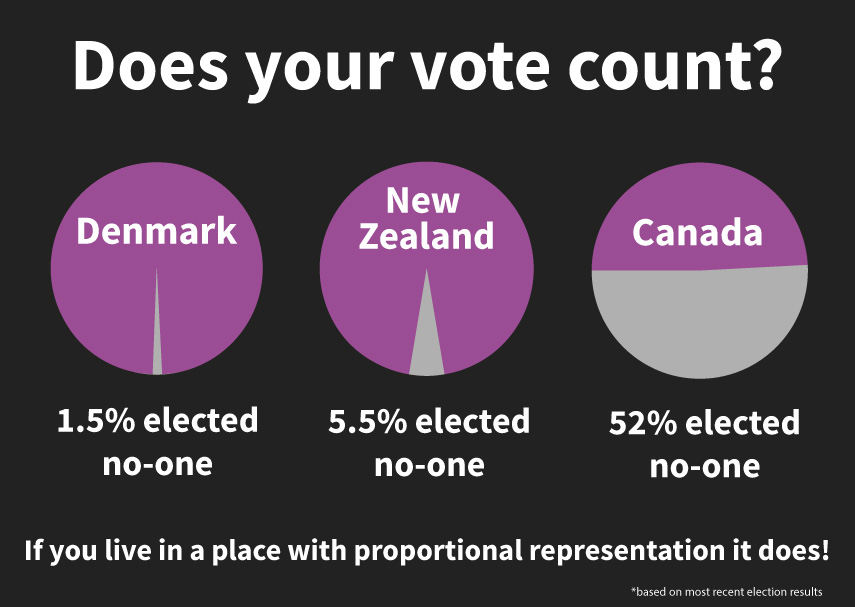
The hard truth is that in a winner-take-all electoral system, choice is mostly illusory. About half of all voters who vote, elect no-one to represent them. With first-past-the-post, the majority are ordering a service that’s never going to be delivered.
Where Canadians fall on the political spectrum versus what first-past-the-post has in store in 2025
Perhaps the most striking finding from the Angus Reid poll is the contrast between where Canadians place themselves on the political spectrum and what kind of government we’re likely to get after the next election.
The largest group of Canadians (39%) told Angus Reid that they place themselves in the political centre. Of those outside the centre, significantly more Canadians see themselves as left-leaning (36%) than right-leaning (24%).
A mere 5% of Canadians describe themselves as “very right wing/conservative”.
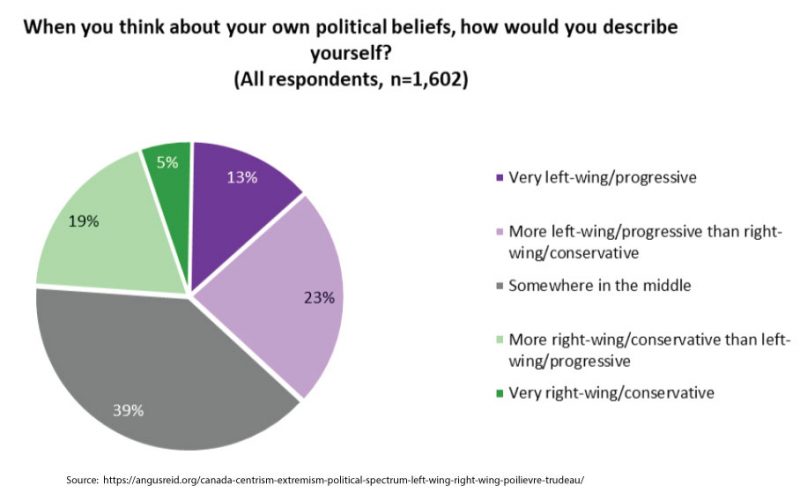
Five percent is a jarring statistic in light of the 2021 Political Compass, which placed the Conservative Party close to the far right.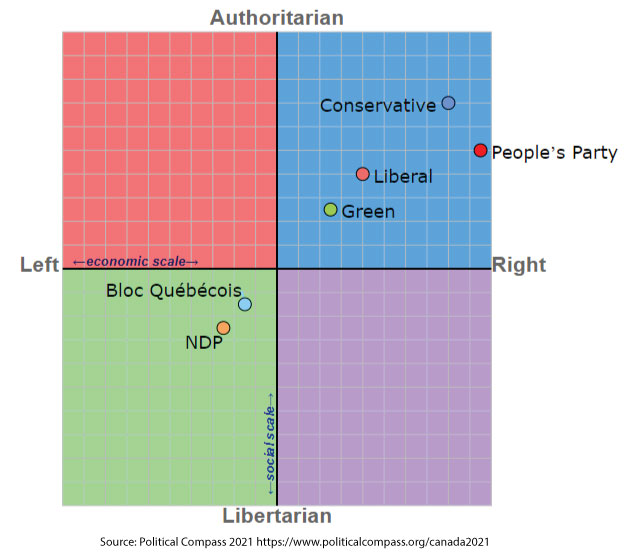
Since the 2021 election, 48% of Canadians told Angus Reid that under Pierre Poilievre the Conservative party has shifted farther to the right and only 11% think the party has shifted left.
Clearly the ideology of the Conservative Party is farther to the right than most of its own voters. It doesn’t matter that our choices are restricted by first-the-post because voters have nowhere else to go. 338 Canada projects that Conservatives are on track to win a landslide false majority: 62% of the seats with only about 42% of the popular vote.
Centrist voters may be the biggest losers in the upcoming federal election. If a significant number of what Angus Reid calls political “orphans” in the centre can’t stomach voting for any of the choices, they may just stay home.
Winning a “majority” government with a shrinking percentage of the electorate may be bad for democracy but it’s proven to be of little concern for parties who can pull it off.
As the 2021 federal election results rolled in Gerald Butts took to Twitter crowing about how the “geniuses” at the data company hired by the Liberal Party had masterfully micro-targeted voters delivering the Liberals so many seats with so little of the popular vote.
Similarly, when voter turnout fell to 43% in Ontario’s 2022 election, Doug Ford was quick to brag about his majority “mandate” with the backing of just 17.8% of eligible voters.
There was a political leader who dared to tell the truth about the nasty consequences of Canada’s electoral system. Back in the days when Justin Trudeau was selling electoral reform, he once proclaimed:
“Quite frankly, political parties shouldn’t be able to appeal to narrow constituencies and suddenly wield enough power to run the entire country.”
On that point, we couldn’t agree more.