
Regional Proportional Representation
PR tailored for Canada's geographyRegional Proportional Representation
Regional Proportional Representation (previously called “Rural-Urban Proportional”) builds on the work of previous commissions and assemblies, and combines elements of top up systems (such Mixed Member Proportional) and multi-member systems (such Proportional Ranked Choice Voting and Open List) to meet the challenges of Canada’s geography.
Proportional representation can only be achieved by moving away from winner-take-all single-member ridings to some other way of electing our representatives. However, ridings in some sparsely-populated parts of Canada are already very large. This has led to proposals to stick with single-member ridings in such areas, and make use of multi-member ridings to ensure proportionality elsewhere.
Such an approach was used provincially for 30 years in Alberta and Manitoba. The cities of Winnipeg, Calgary and Edmonton used Single Transferable Vote (PR-STV) to elect multi-member ridings ranging from 4-10 MLAs. All the ridings outside the cities were single member (winner-take-all) contests.
This produced proportional results in the cities where PR-STV was used, but disproportional results everywhere else. Because there were so many single-member ridings, the overall result for the province as a whole were still quite distorted. Not every voter was able to elect a representative who reflected their values.
A model like this was proposed federally in 2016 by Canada’s former Chief Electoral Officer Jean-Pierre Kingsley. Concerned that such a model would produce insufficiently proportional results, Fair Vote Canada proposed to adapt the model to make it more proportional.
A model very similar to Regional Proportional Representation is used in Sweden, Denmark and Iceland.
How it Works
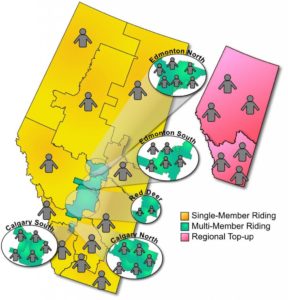 a) Multi-member ridings in most places
The key to the system is to elect representatives in multi-member ridings wherever possible. The number of MPs elected in each multi-member riding would be greater in densely populated “urban” areas and fewer in sparsely populated semi-urban and rural areas.
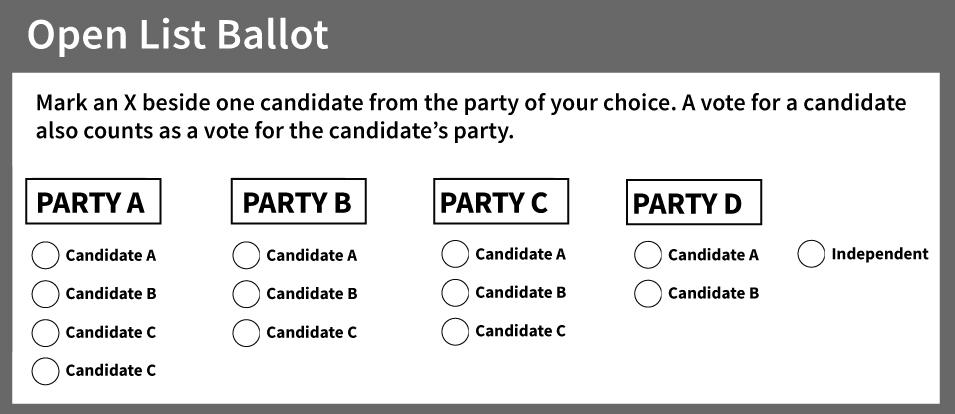
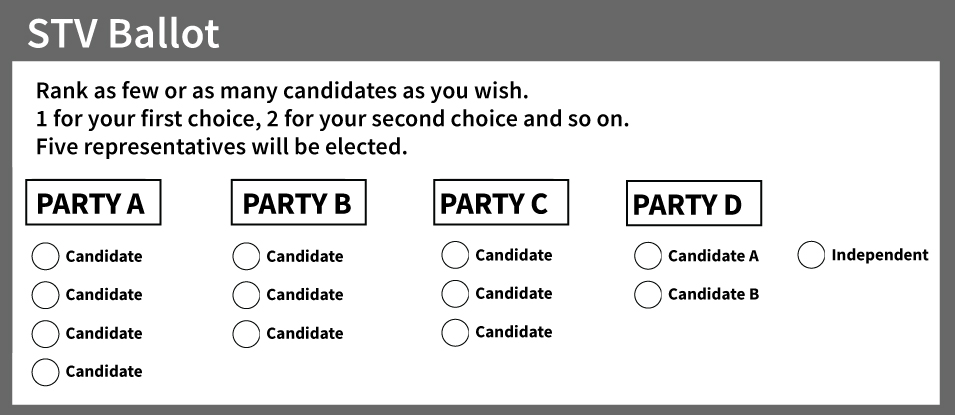
Depending on how the system is designed, voters would elect MPs from across the riding by marking their ballots with a simple X (an open list) or by ranking their choices (proportional ranked choice voting).
b) Single-member ridings in sparsely-populated regions
The exception to the rule would be in sparsely-populated parts of the country which could retain single-member ridings. Voting in such ridings could be with a single X like in first-past-the-post, or by ranked ballot.
c) A small layer of regional top up seats
A high level of proportionality would be ensured by grouping these ridings and multi-member ridings into top-up regions. Because the multi-member ridings are already proportional, we would only need about 10-15% regional top-up seats to make the results in the whole region proportional.
Making room for these top-up seats would require some adjustment in the boundaries of ridings, which would have to become about 15% bigger. However, the accommodation of top-up seats is much easier under Regional Proportional Representation than under Mixed-Member Proportional, because the number of top-up seats needed (Regional MPs) is much smaller. Under MMP, the size of local ridings would have to increase by about 67%.
Voting is simple. Local MPs can be elected using an Open List or Proportional Ranked Choice Voting (also called STV – Single Transferable Vote). MPs elected locally will be proportional to how people voted in your area. If there are five seats, and 40% of voters chose Liberal candidates, then two of the five seats will be Liberal MPs.
Example ballots below:
Top-up seats: Regional MPs (top up seats) could be elected by best runners up (the best performing local candidates in the region who did not get a local seat) or a second ballot with an open list could be used.