

The PC’s decision to raise the amount individuals can donate annually to a political party to $5000 gives wealthy Ontarians an even bigger influence over politics.
In the midst of an affordability crisis, most Ontarians cannot afford to donate thousands of dollars to the party of their choice. For those who can, the PCs will disproportionately benefit from the new rules.
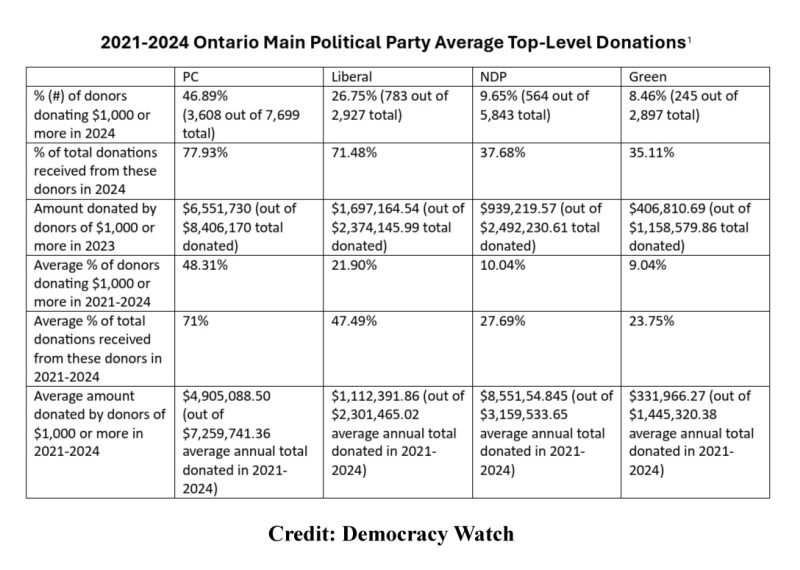
Data compiled by Democracy Watch in 2024 showed that the PCs had almost twice the percentage of donors who gave $1000 or more compared to the Liberals, and about five times the percentage of wealthy donors compared to the NDP and Greens.
Fixed election date legislation can’t fix problems of first-past-the-post
Snap early elections called purely for the partisan self-interest of the governing party are cynical maneuvers that waste public money.
Unfortunately, regardless of whether fixed election date legislation exists or not, as long as a party can get a “majority” with 40% of the vote, governing parties will continue to call early elections anyway.
Provincially, Doug Ford’s PCs are far from the only ones to call snap elections for self-serving reasons – former Premiers John Horgan and Blaine Higgs did the same in recent years.
By doing away with fixed election dates, Doug Ford just ensures that governing parties can call snap elections to capitalize on a small shift in the polls and get less flak for it, since a fixed election law no longer exists to ignore.
Making the per vote subsidy permanent is the right thing to do
Doug Ford’s decision to make the per vote subsidy is a welcome investment in Ontario’s democracy.
The per vote subsidy makes almost every vote worth something by providing funding to parties who earn voter support. It helps smaller parties and parties with less wealthy donors stay afloat, providing them with some public funding to make their voices heard so voters can learn what they have to offer.
Unfortunately, even with a commitment to keep the per vote subsidy, increasing the individual donation limit means that the overall situation in Ontario will be worse.
The priorities of wealthy Ontarians can even more easily drown out those of Ontarians who are struggling to afford rent, groceries or post-secondary education.
To give every voter an equal and meaningful voice in democracy, we need campaign finance reform that levels the playing field and we need proportional representation.