
Following BC’s 2024 election, the BC NDP and BC Green Party negotiated a “Cooperation and Responsible Government Accord” which included an all-party committee that will look at proportional representation.
The Democratic and Electoral Reform Committee includes four BC NDP MLAs, two BC Conservative MLAs and one BC Green MLA.
The committee’s mandate states they will:
“Examine and make recommendations related to increasing democratic engagement and voter participation, and models for electing Members of the Legislative Assembly, including proportional representation and report to the House thereon by November 26, 2025.”
For two weeks in July 2025, the all-party BC Democratic and Electoral Reform Committee conducted public hearings, touring the province hearing presentations from individuals and groups.
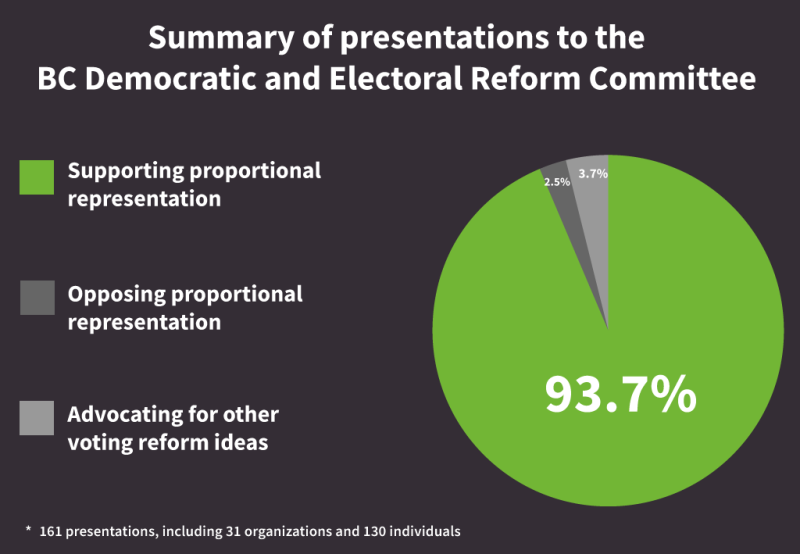
Of the 161 presentations which included an opinion on the voting system, 94% advocated for proportional representation.
Proportional representation was supported by 29 of 31 organizations and 122 of 130 individuals who spoke to the committee.
As BC resident Karren Smith told the committee:
“Of any single change you could accomplish in your life to effect systemic change, it would be implementing proportional representation.”
The only organization who opposed proportional representation was the No PR BC Society (the opponents in the previous referendum).
Only one individual and one organization – the political party Centre BC – argued for Alternative Vote (the winner-take-all ranked ballot).
The feedback the committee heard was clear about how proportional representation should happen:
87% of the organizations and 89% of the individuals who commented on the path to reform said the government should legislate the change.
This is how proportional representation usually happens around the world: by multi-party agreement. (This does not mean every party is always going to agree).
Moving to proportional representation requires both a willingness to negotiate and political leadership.
In addition to individuals and organizations who were given a presentation spot at the hearings, the committee also received hundreds of written submissions. When the written submissions are publicly available, we will send an update and analysis.
The Democratic and Electoral Reform committee meets to discuss what they heard and write a recommendation to the Government in the fall.
For those who’d like to read the transcripts of the public hearings, you can find them here. We’ve included a few more samples of what the committee heard below!
 Making this change to proportional representation is going to ensure that election outcomes more accurately reflect public opinion.
Moving to PR means more candidates from underrepresented communities will actually choose to run as a candidate because they would rather run in a more collaborative PR environment than in the more divisive first-past-the-post system we have now.
Moving to PR is going to put BC on the world stage for democracy and continue to have BC leading in Canada when it comes to giving people a strong democratic voice. The benefits of switching to PR are numerous, and we’re going to reap those benefits for many years to come.”
– Kevin Rupasinghe, Interim Executive Director, Unlock Democracy
 “Proportional representation ensures that parties win seats in close proportion to their share of the vote. It reflects voter intent more accurately and encourages a more collaborative and inclusive political culture.
And for young and first-time voters, it really matters. When votes feel ineffective, when outcomes seem predetermined, participation suffers. Further, the perceived necessity of strategic voting further undermines their sense of fairness and vote inefficiency.
These barriers come up time and time again in our work, and there is little that civil society can do to solve for this alone.
Electoral reform would remove that barrier, making participation feel more meaningful.”
– Samantha Reusch, Executive Director, Apathy is Boring (a non-partisan, charitable organization that supports and educates youth to be active and contributing citizens in Canada’s democracy).
 “I’m here today in my role as the Executive Director and, more personally, as an immigrant to this country and a human rights activist.
I have a strong belief in the power of civic engagement and that as a country, at both the national and regional levels, we still have far to go to create a more robust, representative and inclusive democracy…
We know our supporters care deeply about this issue. Last week, in anticipation of this presentation, we sent out a short survey to our supporters in B.C. We received over 2,300 responses. On the question of “How important is electoral reform to you?” 96 percent of our supporters said that this was either very important or important.”
-Shanaaz Gokool, Executive Director, Leadnow
 Voting is a huge part of feeling like you’re having your voice heard. We all agree on that.
Imagine being in a place you love and where you’re going to remain for the rest of your life but where the party you prefer never wins.
Imagine going for decades voting and always having someone you disagree with go to Victoria to represent you….
I don’t understand why we can put up with a system that does that.
Democracies are better when people feel well represented, because that probably means they are well represented. Multi-member districts, obviously — and the evidence supports this — make people feel better represented because more of them have elected somebody who they agree with.”
– Fred Cutler, Associate Professor of political science, UBC
 What’s basically happened for me in the evolution of my views….
I believe it was around 2005 that British Columbia had a referendum on electoral reform, under the previous Premier, Gordon Campbell. At that time, I voted no. I didn’t really take much time to study the issue. I had this confidence or smugness: “Well, if it ain’t broke, why fix it? We’re fine in Canada.”
Over the years, we’ve seen tremendous changes globally and in our country.
In a nutshell, we are seeing the rise of authoritarianism, the erosion of public confidence in democratic norms, extreme partisanship, regionalism and polarization. My view, and my submission to you, is that we need a democratic system that reflects the real will of the people. “
– Bill Sundhu
 “My personal background includes having been a research scientist, a professor of statistics, and later, a businessman.
I have grandchildren and more on the way so family well-being is especially important to me.
We need a modern voting system for its practical outcomes.
No voting system can stop the voters from making bad choices. Yet proportional representation is better at everything.”
– Maxwell Anderson
(*Read his testimony in which he cites many studies connecting PR to practical outcomes on measures of democracy, quality of life, and economic prosperity).