
Researchers Find Seven Countries with Proportional Representation are an “Island” of Contentment
Faith in Democracy in Peril Around the World
Researchers Find Seven Countries with Proportional Representation are an “Island” of Contentment
Cambridge University’s Centre for the Future of Democracy released a widely covered report this week sounding the alarm bells about the decline in citizens’ faith in democracy around the world. Dissatisfaction with democracy is at an all-time high, particularly in established democracies.
While most of the coverage focused on the overall findings of a growing crisis and current political events, the purpose of the Centre’s report was clear:
The Centre’s aim is to move away from a fixation on the here and now, and beyond the who and what of democratic politics – who is going to get elected, what are they going to do? – to look at the how.
How do democratic decisions get made and how can they be made differently? How can the consent of losers and outsiders be achieved? How can new social divisions be bridged?
And if we can’t do these things, how will democracy not merely survive but flourish in the future?
The report provided some key findings and insights in this regard:
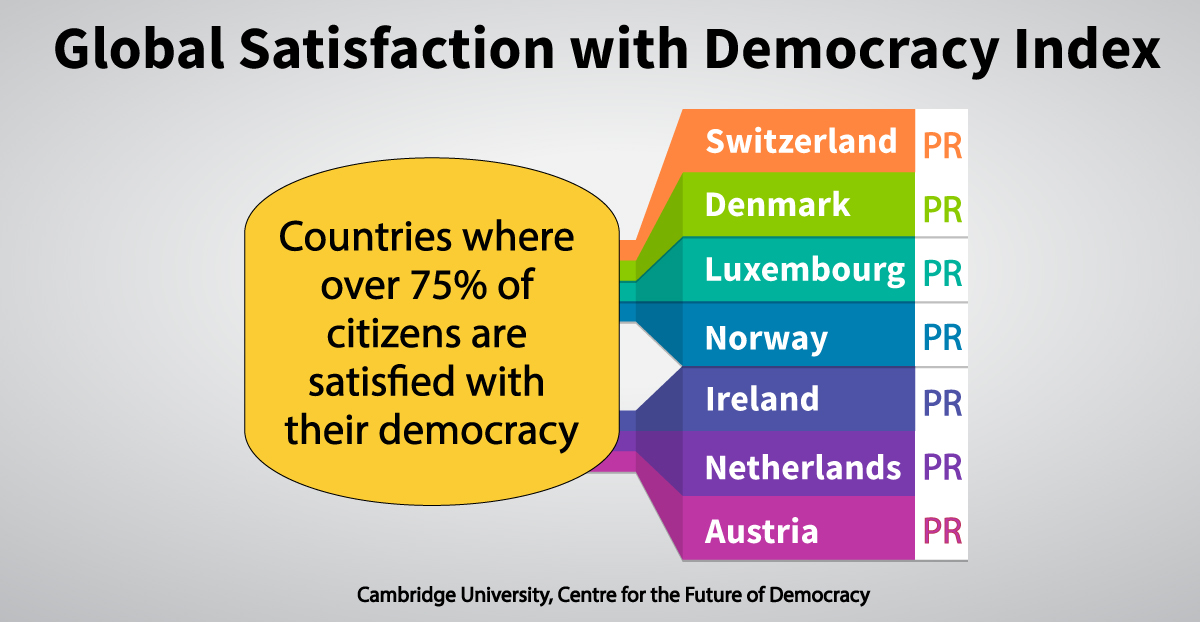
- The authors find a group of seven countries; Switzerland, Denmark, Norway, Ireland, the Netherlands, Austria and Luxembourg, which they call “islands of “contentment,” where satisfaction with democracy has actually increased and is reaching all-time highs. All seven use proportional representation.
- Among the Anglo-Saxon democracies the proportion of citizens who are dissatisfied in the US and the UK has doubled since the 1990s. At the other end of the spectrum is New Zealand, which has a proportional voting system and appears to have avoided a trajectory of soaring public discontent.”
- The authors point to well-established research showing that citizens in countries with proportional representation are more satisfied with their democracy, even if the party they supported is not in power. The authors point to the problems of winner-take-all voting, including “safe seats,” entire regions feeling excluded from decision-making, and polarization of citizens into competing “tribes.”
If the Canadian government is serious about improving voter engagement and satisfaction beyond meaningless tropes, the answer is obvious: The promise Justin Trudeau himself made to the electorate in 2015 to make every vote count.